Pain Kinks Explained for Pleasure Doms and Subs

How can a pain kink feel pleasurable—and does enjoying it mean you’re a masochist?
Summary:
Pain in BDSM is not simply about hurting someone—it is the intentional use of sensation to create pleasure, deepen arousal, and reinforce power exchange. Because pain and pleasure share overlapping neural pathways, factors such as consent, anticipation, emotional connection, and context can transform painful sensations into intensely pleasurable experiences. This guide explains the science behind pain and pleasure, why people enjoy pain in BDSM, and how to safely use sensation, intensity, and context to create more fulfilling and pleasurable scenes.
Prefer to watch a video rather than read? Click play. Otherwise, continue below for the rest of the article.
One of the paradoxes that is often difficult for those newly initiated into BDSM to understand is how pain could be pleasurable—and why anyone on earth would want to be hurt, on purpose. Did you know that until 2013, sadomasochistic preferences were classified as mental disorders, even when they were consensual? That’s how strange people who enjoy pain kinks can appear to the wider public.
For those who lean more pleasure-focused, the concept of pain can feel antithetical. While some pleasure-focused submissives may feel hesitant about trying pain at first, I’ve more often seen those who might consider themselves Pleasure Doms struggle with a different mental hurdle: “I don’t want to hurt them,” even as their eager little sub is begging for it.
That was certainly me in the beginning. I don’t consider myself a Sadist, and I don’t seek out giving pain for my own pleasure. However, I promise you this: the first time you see a woman in the throes of ecstasy—moaning uncontrollably from having her nipples bitten hard, her ass turning different shades of red, or cumming from the pain you’re dishing out—it will permanently change how you think about giving pain.
Time and time again, I’ve personally heard submissive women say they wished their previous partners had been rougher, had given them a little more pain, even when they didn’t consider themselves masochistic. This misunderstanding is most commonly seen in pairings between a masochist and someone who equates pleasure solely with the number of orgasms they can produce.
So whether you’re on the receiving end of pain or the one delivering it, let’s help you wrap your head around pain—so you can add an entirely new dimension to your pleasure focus.
Related: If you want to go beyond “just giving her pleasure” and become the man who orchestrates every shiver, gasp, and moan… Developing Dominance will show you how. It’s the step-by-step guide to leading with the same confidence, precision, and erotic presence I’m talking about here. You can find out more here.
What Is Pain?
This is the biggest puzzle you need to solve to understand why pain can be so pleasurable. Fortunately, this question has been extensively researched in science. I’m going to break this down—and be a bit overly reductionistic—in order to bring sharper clarity for our purposes here. That said, I strongly recommend reading the literature on the relationship between pain and pleasure if you want a deeper dive.
At its most basic level, pain is simply one category of physical sensation within a broad array of biofeedback signals. You experience a potentially dangerous sensation on or in your body; nociceptors in the skin send signals to your nervous system; and your brain interprets those signals as negative strain—damage, or the threat of damage, to the system. Often (though not always), the more direct, immediate, or extreme the threat, the more intense the pain signal will be.
But here’s the key point: pleasure is also a category of physical sensation.
In fact, research shows that pain and pleasure are processed through many of the same brain structures, including shared neural pathways involving the dorsal root ganglia, the nucleus accumbens, and mechanisms responsible for maintaining homeostatic balance.
When your body receives sensation, your brain is interpreting electrical signals from the skin. Depending on various factors—such as prior experience, context, and innate responses—those signals can be experienced as pleasure or pain.
Sensation → Signal → Interpretation → Pain or Pleasure
What influences that interpretation is what makes all the difference in BDSM. We’ll come back to that shortly.
First, it’s essential to understand that pain and pleasure exist on a connected continuum. The brain treats them as opposite ends of a scale and constantly works to maintain balance. When you experience high pleasure (for example, through drugs), the brain often tilts toward pain to compensate—think withdrawal or hangovers.
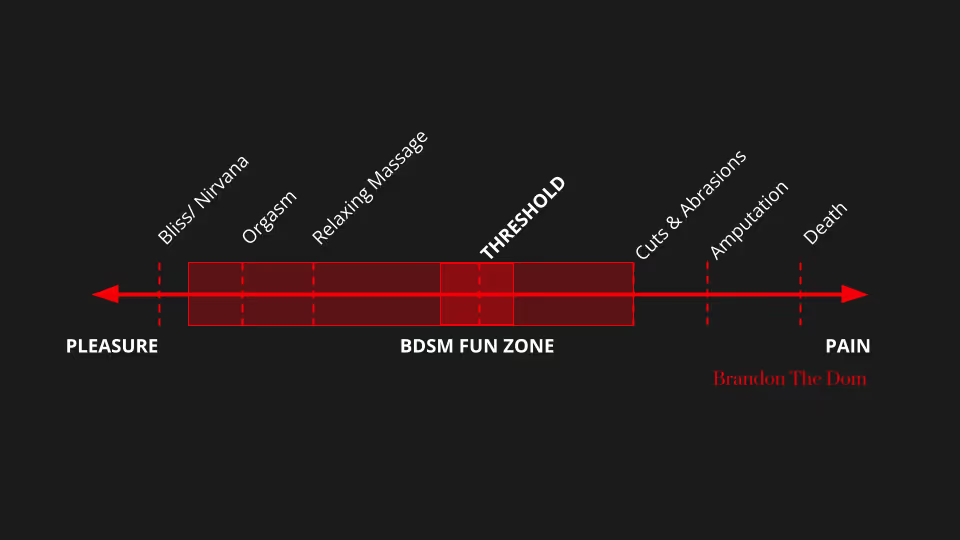
For every person, there exists a threshold at which a given sensation creates too much strain on the system and becomes unbearable. This is the tipping point where a pleasurable sensation may become painful—or where a painful sensation may become pleasurable (hello, BDSM). That threshold varies widely between individuals and can even vary within the same person depending on context.
A person’s pain threshold can shift based on:
- Personal and genetic factors
- Intensity of the stimulus
- Duration of the sensation
In BDSM—particularly in sadomasochistic play—we aren’t simply “causing pain.” We are modulating sensation in order to influence where someone’s threshold lies and how their brain interprets what they’re feeling. That sensation might be as gentle as a feather or as sharp as a needle.
Let’s look at examples from opposite ends of the spectrum.
For my pleasure-focused, orgasm-chasing friends: even something as pleasurable as an orgasm can become extremely painful when intensity or duration exceeds a threshold. This is the basis of overstimulation—bringing your partner to orgasm and, instead of stopping to allow recovery, continuing stimulation. As orgasms stack, the line between pleasure and pain blurs and can rapidly tip into discomfort or outright pain.
Now let’s flip to the other end of the spectrum.
For my tattoo-covered friends who like to call their sessions “pain therapy,” you already understand how enduring prolonged pain can eventually feel pleasurable. A similar process occurs during BDSM activities such as spanking.
Your Dom has been spanking your ass until it turns various shades of red. This places your central nervous system on high alert, triggering the adrenal cortex to release stress hormones—primarily adrenaline and cortisol.
Adrenaline increases pain tolerance and can contribute to feelings of heightened focus or euphoria.
Cortisol prepares the body to repair tissue, which is useful both in BDSM scenes and in genuine emergencies. It suppresses non-essential systems like digestion and reproduction while activating endorphins—chemicals that reduce pain and can induce euphoria.
When cortisol is present in a context of trust and relaxation (as is common in established D/s dynamics and subspace), it can also contribute to increased oxytocin release. Oxytocin promotes bonding, trust, attraction, and emotional safety. When painful sensations are combined with pleasurable or arousing experiences—such as orgasms—oxytocin release can increase even further.
Finally, dopamine may be released through certain forms of pain, through orgasm, or through anticipation and reward—like preparing for a scene or being the best good girl there ever was. ;)
Why Do People Enjoy Pain in BDSM?
You’re probably starting to grasp how pain can become pleasurable. But to really understand why pain is so sought after in BDSM, you have to understand context.
Context is what shapes how sensations are interpreted. Context is what makes your submissive beg for a beating when, under normal circumstances, they’d cry like a baby after stubbing their toe.
When sensations occur within the context of BDSM play, several key factors are present:
- There is an emotional and psychological reason for why the sensation is occurring, often created through role play or power dynamics.
- There is a positive interpersonal or social connection with the person delivering the sensation.
- You enter into the experience voluntarily.
- You have control over the intensity and the ability to stop it.
- You anticipate the sensation and have time to prepare for it.
- The experience may be sexually arousing.
All of this makes it far more likely that the sensation will be registered as pleasurable.
Now contrast that with something like stubbing your toe.
When you stub your toe:
- There is no emotional or psychological context.
- There is no relationship or social connection with the object causing pain.
- You did not choose the experience.
- You had no control over it.
- You couldn’t anticipate it or prepare for it.
- It’s not sexually arousing.
Context is everything. It’s the mechanism that allows the physiological and psychological processes I described earlier—such as in the spanking example—to occur.
One integrative research model describing how pain becomes pleasurable in BDSM looks like this:
.avif)
- Before pain is experienced, there is an existing emotional and interpersonal context shaped by the present situation, memories of past experiences, and a sense of control. These factors may already be facilitating sexual arousal.
- Sexual arousal present before or alongside pain acts as a pain relieving drug, altering neurochemistry through changes in dopamine and oxytocin levels.
- Positive anticipation of pain, shaped by context and arousal, plays a crucial role in modulating pain perception. Simply knowing a painful stimulus is coming—20 to 40 seconds in advance—can significantly reduce how painful it feels, as the brain prepares and buffers the response.
- Context, arousal, and anticipation together create the conditions under which pain sensations are more likely to be interpreted as pleasurable.
- Once pain is introduced, nociceptor stimulation engages both bottom-up and top-down processing, producing changes in dopamine, cortisol, endogenous opioids, and endocannabinoids, further shaping the psychological and physiological response.
- These combined conditions may promote mindfulness and lead to an altered state of consciousness—commonly referred to as subspace—which contributes to how pain is experienced as pleasure within BDSM.
This model describes only one way pain is perceived in BDSM, commonly referred to as transformed pain. Pain, however, can be experienced in several distinct ways:
- Transformed pain: A person actively modifies how painful sensations are processed so they are experienced as pleasure rather than pain. This is the most relevant category for pleasure-focused individuals.
- Autotelic pain: Pain is experienced as painful and enjoyable without being transformed. This is pain for pain’s sake and is often what people associate with masochism.
- Sacrificial pain: Pain is framed as an undesirable sensation willingly endured for a greater purpose—such as pleasing a Dom’s desire for pain or receiving discipline.
- Investment pain: The reward comes not from the pain itself, but from having endured it. Pain is experienced as a challenge, and withstanding it produces feelings of achievement, pride, or accomplishment.
Pain may also be pursued for reasons that have less to do with sensation itself and more to do with identity or meaning—enhancing feelings of helplessness and submission, reinforcing a sense of belonging through visible marks, or providing catharsis that helps release emotional stress and forget the pressures of daily life.
Whatever the motivation, I promise it goes far beyond simply wanting to be hurt. And for the person receiving the sensation, they may not be experiencing it as pain at all.
How to Use Pain in Pleasure-Focused Play
Now that you understand the pain–pleasure relationship, let’s turn our attention to how you can use your control over sensation to enhance your play.
The first shift you need to make is mental: move away from the idea that you are causing pain and toward the idea that you are creating sensation.
When you view it this way, your focus naturally shifts to what kinds of sensations you want to create, rather than whether something is painful or not.
The second shift is to see yourself as a facilitator of sensation—someone whose role is to skillfully modulate another person’s threshold. No, it doesn’t sound sexy, but it gets the point across.
As a facilitator of sensation, you have four primary elements you can control:
- The type of sensation you create
- The context in which the sensation occurs
- The intensity of the sensation
- The duration of the sensation
By manipulating these variables, you can move your partner’s perception toward pain or pleasure—or shift the threshold at which one becomes the other.
Choose a Sensation
You can use almost anything to create sensation, including nothing more than your own hands, mouth, or body. And with any tool—or body part—you can create vastly different sensations depending on how you use it.
Below are categories to help spark ideas.
Types of Sensation
Impact & Percussive Sensation
- Spanking (hand, over clothing or bare)
- Paddling
- Flogging
- Caning
- Crops, whips, straps
- Slapping (face or body)
- Drumming or rhythmic tapping
- Percussive vibration (thuddy vs. stingy impact)
Compression, Restriction & Pressure
- Hair pulling
- Choking / breath play
- Body-weight pinning
- Manhandling
- Corsetry
- Chest binding
- Muscle squeezing
- Smothering with limbs or body positioning
- Restricting movement (arms held, knees pinned)
Sharp, Prickly & Intense Sensations
- Biting
- Scratching or clawing
- Nipple pinching
- Clothespins
- Fingernails
- Wax drips (controlled heat)
- Ice tracing (sharp contrast)
- Pinwheels / Wartenberg wheels
- Needles (consensual, controlled play)
- Light cutting or scratching implements
Temperature Play
- Ice
- Cold metal
- Warm hands
- Melted wax
- Breath (hot vs. cool air)
- Temperature-contrast cycles
- Heating pads (low intensity)
- Chilled objects
Texture & Surface Stimulation
- Feathers
- Fur
- Silk
- Leather
- Rough fabrics
- Brushes (soft or coarse)
- Sponges
- Fingertips vs. knuckles
- Light abrasive textures
- Oil or lube to change friction
Restraint & Immobility
- Bondage (rope, cuffs, tape)
- Suspension
- Position holding
- Forced stillness
- Restricted posture
Sensory Overload
- White noise or music
- Removing one sense to heighten others
- Overstimulating a single body part
- Rapidly switching sensations
- Sustained, repetitive sensation
- Teasing without release
Erotic Pain Through Arousal
- Orgasm control
- Orgasm denial
- Edging
- Ruined orgasms
- Forced arousal without release
- Prolonged arousal states
- Tease-and-deny cycles
Endurance & Threshold Play
- Holding uncomfortable positions
- Sustained sensation without escalation
- Repetitive impact
- Time-based challenges
- “How long can you take this?” dynamics
Body Awareness & Internal Sensation
- Muscle fatigue
- Shaking
- Trembling from exertion
- Breath-restriction awareness
- Heightened heartbeat
After-Effects & Residual Sensation
- Marks and bruising
- Tenderness
- Post-scene hypersensitivity
- Clothing rubbing against sore skin
Even a single object can be used in ways that range from soft and traditionally “pleasurable” to intense and painful.
For example, I have a cowhide suede leather flogger with rounded falls.
- If I run it lightly across the skin, it feels soft and soothing.
- Used with certain techniques, it delivers a light thud that feels almost like a massage.
- Swung with all the falls together, it lands as a heavy thud—like a stern spanking.
- Whipped like a towel, it stings sharply at a single point of contact.
- Used by the handle, it can drum or club the body.
And that’s just one tool.
What matters most is not what you use, but that you understand the risks associated with each practice and use safe techniques. We want to hurt them—not harm them.
If you’re still wrestling with the idea of hurting your partner, I recommend choosing sensations that genuinely turn you on. For instance, I wasn’t initially much of a biter—besides around the neck. But when I started biting other areas and my partners moaned or gasped in response, it turned me on deeply. Once I focused on that feedback, biting quickly became one of my favorite things to do.
Context of a Sensation
Recall how important context is in determining whether pain is perceived as pleasurable.
Many people focus heavily on techniques for creating sensation. That focus is important—primarily to reduce the risk of injury or harm. What’s often overlooked, however, is why a particular technique is being used in the first place.
How you create a sensation is more important than what sensation you create.
Two Doms can perform the exact same actions on the exact same submissive and produce entirely different experiences. So even if you become technically proficient at every practice in BDSM, you still need to master the principles of delivery if you want those actions to evoke the emotions and fulfill the desires she’s craving.
What’s missing is context.
For example, yes—you could spank your submissive simply because it feels good on her ass. But you could also spank her because she’s been a naughty little girl who isn’t supposed to be thinking dirty thoughts while she’s working. One of those engages the body. The other engages the mind—and arousal has far more to do with the mind than the body alone.
When thinking about context, ask yourself:
- What is the context of this sensation? Why is it happening?
- What is the story behind it?
- What role or power dynamic between us is driving this sensation to occur?
There are also several other critical elements of context you should never forget.
- Volition: Your partner must be entering into the experience willingly. Don’t spring sensations on someone you haven’t discussed beforehand, even if you think they’ll like it.
- Agency: Safewords exist to preserve the submissive’s agency. They ensure that your partner can opt out of a particular sensation—or the entire experience—once it begins.
- Anticipation: Think of this as sensation foreplay. Use dirty talk to describe what you’re going to do to her. Lay out the tools you plan to use—or make her fetch them for you. Let her see them. Touch her with them lightly first, drawing them slowly across her skin, before escalating to something more intense.
Context is what transforms sensation from bland—or merely painful—into something deeply arousing and incredibly pleasurable.
Intensity and Duration of Sensation
You’ve chosen a sensation and given it the proper context. Now the next two elements you’ll be working with—always in tandem—are intensity and duration.
With any sensation you create, you can adjust intensity by increasing or decreasing:
- Pressure
- Speed
- Force
- Direction
- Rhythm
- Amount
Intensity doesn’t necessarily mean doing something harder so that it hurts more. For example, a light feather might feel pleasurable against the skin at first, but with continued use it can become ticklish. Given enough time, that ticklish sensation may become irritating—and with long enough duration, it can even become painful (or at least mentally anguishing).
Just as we discussed with continuing stimulation past the point of orgasm, any pleasurable sensation can become painful through overstimulation when duration is extended.
On the other end of the spectrum, some painful sensations become more pleasurable when delivered with alternating cycles of intensity and relief—such as spanking—while others may feel better when the intensity is held steady for longer periods. Practices like tattooing or nipple clamps often fall into this category, where breaks followed by reapplication can feel worse than sustained sensation.
This means you’ll be constantly adjusting two dials—intensity and duration—throughout a scene to locate the threshold where pain begins to blur into pleasure.
Let’s look at spanking as an example to illustrate several core principles.
Bonus: Download the exact scene that I've used full of spanking, light impact play, and some sexual fun to tie pain and pleasure together and make her squirm with every swat to her butt!
Gradual Warm-Up
Preparing your submissive’s body for pain is essential. First, it allows them to sink into bodily sensation and mentally prepare for what’s coming. Second, it increases blood flow to the area, which helps mitigate mild tissue trauma while simultaneously heightening sensation in erogenous zones.
To warm your submissive up for spanking:
- Start by acclimating her to touch. Run your hands along her body and curves. Incorporate light scratching with your nails, kisses, or gentle nibbles.
- Massage the butt and thighs to promote blood flow and raise the skin’s temperature. If you’re feeling generous, let your fingers graze near the sweet spot, offering the anticipation of genital stimulation without fully delivering it.
- Even in scenes framed as punishment, you can begin spanking over padded clothing—such as jeans—to create the illusion of severity. By the time her clothes come off, she’s already warmed up, allowing you to continue at the same intensity or escalate further.
The longer the duration of the scene—and the more gradually you increase intensity—the higher your partner’s pain threshold will rise. This makes it more likely that larger amounts of pain will be experienced as pleasurable. Take your time.
Start at the Appropriate Intensity
As you transition from warm-up to actual spankings, your first strike should be intentional—it sets the tone for the rest of the scene.
If spanking is being used primarily for pleasure, start light and low. Use gentler techniques, such as low-height gravity spanks or a cupped hand, and establish a rhythm of light taps before gradually increasing intensity.
If spanking is framed as pain or punishment, begin with a single medium-intensity strike, then back off to a lower intensity. That first blow creates a sharp intake of breath and a moment of shock without overwhelming pain. The subsequent lighter strikes continue the warm-up, preparing her to take more later.
Regardless of intent, the general rule is to start at lower levels of intensity and increase gradually as blood engorges the area and pain tolerance rises due to the release of adrenaline, cortisol, and endorphins.
If it’s your first time spanking a particular submissive, you can gauge her tolerance by delivering a strike and asking her to rate the pain on a scale of 1 to 5—where 1 feels like nothing and 5 represents the upper edge of her pain threshold.
Find a Rhythm
Effective spanking relies on rhythm—both repetition and disruption.
A repeating pattern might look like nine light spanks followed by one medium spank on one cheek, then repeating the same sequence on the other. This allows your submissive to acclimate to the sensation and can induce a lightly hypnotic state, similar to a metronome.
Pattern interrupts—changing timing, intensity, location, or technique—prevent the body and mind from becoming too accustomed to the sensation. This keeps the experience engaging rather than monotonous.
Experiment with rhythm, pace, placement, and force. Establish a pattern, then break it. Then create a new one. This dance between predictability and surprise is one of the most powerful tools you have when working with intensity and duration.
Communication During Pain Play
If you’re using pain for pleasure, there’s an art to keeping it right at the threshold—enough sensation to be arousing, but not so much that it tips into plain pain. As a scene progresses, your partner’s pain threshold and tolerance will shift, which means you need to continually gauge where that threshold currently lies.
Of course, you can always ask your partner directly—where they are on a scale of 1 to 5, or whether they want it harder or softer. Another more dominant way to assess your submissive’s state is to have her count the spankings and ask for another. This keeps her engaged and present while still giving you feedback.
Eventually, though, the goal is to allow your partner to relax fully and stop having to verbalize. When that happens, she can sink more deeply into the trance-like state of subspace. To do that, you need to rely less on words and more on observation.
Instead of asking, watch her body.
Your submissive’s body language will tell you a great deal about how she’s receiving your touch.
Signs the intensity feels good:
- Low moaning or growling
- Deep, steady breathing
- The body tenses briefly, then relaxes
- Movement that follows a steady rhythm
- She pushes her ass back toward you, inviting more contact
Signs the intensity may be getting too much:
- Gasping or a sharp intake of breath
- Moaning or vocalization stops suddenly
- The body stiffens and does not relax before the next strike
- A sharp cry of pain
- The body or ass tenses before the blow is delivered
- Pulling her body or ass away from impact
Learning to read these signals allows you to adjust intensity and pacing in real time—keeping your partner right where sensation, arousal, and surrender overlap.
Receiving Sensation
For the bottom or submissive receiving sensation, there are several things you can do to actively modulate your own threshold and transform pain into pleasure.
The first is presence—bringing mindful attention to the experience itself. Because our culture is deeply pain-avoidant, our instinct when we feel pain is to distract ourselves from it or mentally pull away. Those who practice mindfulness, however, know that directing attention toward discomfort—easing into it and accepting it—often reduces a portion of the pain and makes it far more manageable.
Avoid tensing your muscles in response to sensation. Instead, consciously relax into it.
Deep breathing is one of the most powerful tools for this process. Breathe slowly and intentionally into the area receiving stimulation. This supports your body’s natural pain-management mechanisms and helps prevent excessive tension, which can amplify discomfort.
As you begin to truly grasp the idea of pain as a stimulus, rather than something inherently negative, you may notice that it feels like intense energy concentrated in a specific area of the body. Through mindful attention and breath, you can start to disperse that intensity—circulating the sensation throughout your body rather than letting it remain locked in one place.
This shift—from resisting pain to working with sensation—is one of the most important skills a submissive can develop when learning to experience pain as pleasure.
From Pain to Pleasure
For both the giver and the receiver, changing your relationship with pain unlocks an entirely new range of erotic possibilities. You don’t need to be sadistic to find deep satisfaction in giving your partner pleasure through pain, and you don’t need to identify as masochistic to crave pain as part of your play. Wanting that experience doesn’t mean there’s anything wrong with you—especially when you understand that these responses arise from normal, well-documented bodily processes and adaptive mechanisms.
Expanding how you define archetypes like the Pleasure Dom allows you to see pain for what it truly is: not an end in itself, but one of many tools available to shape sensation, deepen arousal, and facilitate surrender. When used skillfully, pain becomes another language of pleasure—one you can modulate, direct, and ultimately command.
Learn the science. Apply the principles. Stay intentional with context, intensity, and duration. Do that, and pain stops being something to fear or avoid—it becomes a powerful pathway to pleasure.
FAQs
Why does pain feel pleasurable in BDSM?
Pain can feel pleasurable because the brain processes pain and pleasure through shared pathways. When combined with arousal, trust, and anticipation, painful sensations can be reinterpreted as enjoyable.
Does enjoying pain make you a masochist?
Not necessarily. Many people experience “transformed pain,” where sensation is perceived as pleasure rather than pain, without identifying as masochistic.
What role does context play in pain pleasure?
Context determines how the brain interprets sensation. Consent, emotional connection, anticipation, and sexual arousal all increase the likelihood that pain will be experienced as pleasurable.
What happens in the body during pain play?
The body releases chemicals like endorphins to reduce pain, dopamine for reward, cortisol for stress response, and oxytocin for bonding. Together, these create altered states and increased tolerance.
What are the different types of pain in BDSM?
Types include transformed pain (experienced as pleasure), autotelic pain (enjoyed as pain itself), sacrificial pain (endured for a purpose), and investment pain (valued for achievement).
How do you safely use pain in BDSM?
Focus on creating controlled sensations rather than causing harm. Adjust intensity and duration gradually, maintain communication, and ensure consent and clear boundaries.
Can pain increase sexual arousal?
Yes, pain can heighten arousal by stimulating the nervous system and enhancing emotional intensity. When paired with sexual context, it can amplify pleasure significantly.
How do you turn pain into pleasure?
By controlling sensation, building anticipation, and maintaining a safe emotional context. Gradual intensity, trust, and arousal help shift perception toward pleasure.
Is pain necessary for BDSM?
No, BDSM can exist without pain. Pain is just one of many tools used to create sensation, deepen connection, and explore power dynamics.

Master the 12 essential steps to become a good Dom—build the skills, mindset, and presence of a man she respects, desires, and willingly surrenders to—inside and outside the bedroom.
Learn MoreRelated Articles

A Pleasure Dom is Not What You Think It Is
Continue Reading
BDSM Spanking Guide: Techniques, Positions, and Safety Tips That Actually Work
Continue Reading
Orgasm Control: So Much More Than Edging
Continue Reading
