The Ultimate Guide to Power Exchange in Dom/sub Relationships

What is power exchange, and how can you create a D/s dynamic that actually works in real life?
Summary:
Power exchange is the consensual sharing of authority, control, or responsibility between partners to create a relationship that fulfills both people's needs, desires, and goals. While it is the foundation of Dom/sub relationships and many BDSM dynamics, healthy power exchange is built on trust, negotiation, communication, and ongoing consent—not one person having unlimited control over the other. This guide explains how power exchange works, why people are drawn to it, the different types of power exchange, and how to intentionally build a D/s dynamic that is safe, sustainable, and deeply fulfilling.
Prefer to watch a video rather than read? Click play. Otherwise, continue below for the rest of the article.
Power exchange. Whether you want to harness power—or willingly surrender it to someone else to be, consensually, used—the allure can be intoxicating. It lies at the heart of BDSM: from giving over control to a Top for one extraordinary scene, to taking control of the direction of another person’s life as a Dom.
Despite how often we see power exchange portrayed, it’s far more difficult to understand how it actually works—especially within a relationship. We see the devoted submissive happily kneeling at their Dominant’s feet, but we don’t see the negotiations, structure, and foundational practices that made that moment possible.
In this article, I’ll help you build an understanding of power exchange from first principles and show you how to start a power-exchange or Dom/sub relationship—one that actually works with your real life, not against it.
Related: Exploring D/s alone gets exhausting. If you’re tired of piecing things together from articles and hoping you’re doing it right, The Red Room is where real conversations happen. Private. Intentional. Supportive. Join your people here.
What Is Power?
To understand power exchange, we must first understand power itself. This understanding is fundamental to all relationships, including the one you have with yourself.
At its core, power is the ability to act freely—when you want, how you want—without external forces dictating your choices. It’s the capacity to take a vision in your mind and turn it into reality without restriction or interference.
Power functions like weight placed on one side of a leverage point. We use it as leverage to get what we want—or what we think we want.
Why Are We Attracted to Power?
The simple answer is this: power grants control over an abundance of whatever currency holds value in a given social context. That currency might be manpower and social status (as in politics), money, or other resources that shape a particular society.
Our monkey brains, wired for survival, evolved in a state of scarcity. We instinctively seek security, and abundance provides the illusion of comfort and safety. This drives us to accumulate resources—and to depend on those who have them.
As human societies developed, the world became a marketplace of exchanged resources. We trade what we have for what we crave. If you’re cold and hungry in a cave, constantly hunting for your next meal, you may be willing to bargain—even to the point of relinquishing power over yourself to someone with greater resources.
What Is Power Exchange?
What do you think lies at the heart of power?
For most people, the first thing that comes to mind is control, right? After all, I’ve just explained that the person who holds power controls resources—and that’s what makes power so attractive. But control only comes after power has been attained.
So how did they get that power? And why do people continue to willingly give it to them?
People generally yield power in exchange for what they need and want.
Think about this for a moment: to some degree, all of us hand over control of our lives to other people every single day. We make these exchanges because we believe the other party—whether it’s an employer, a corporation, or a government—will benefit us in some way. The most prominent benefit is that we don’t have to worry about the logistical challenges of meeting our basic needs. Hell, people will even accept tyranny if it provides safety and food on the table.
What lies at the heart of power is not control, but responsibility.
When you take responsibility for providing people with what they want and need, they will hand over their resources—and sometimes even a degree of control. These exchanges occur because you have more power (remember: the ability to do or say something) than the other person and can make things happen.
This also means that those who hold power must be able to understand, read, and feel what others want—and then reliably deliver it in exchange for that control.
Now that you understand how power works on a broader level, how does this concept apply to power-exchange relationships?
Power exchange is the act of structuring relationships through a negotiated, deliberate, and consensual exchange of power, based on the idea that all parties get what they need.
This phenomenon is not exclusive to BDSM. Consider a relationship in which one partner makes significantly more money than the other. The higher-earning partner may expect to decide where the couple takes their big vacation each year. If this expectation is unspoken and assumed, the relationship can suffer—often through resentment or conflict.
But what if the couple explicitly negotiates this decision-making process and agrees, consensually, that the higher-earning partner chooses the vacation destination, while the other partner retains a “veto” power?
That arrangement is an exchange of power.
In the context of BDSM, similar exchanges occur, though they are often more intentional and explicit. The person holding power in a BDSM scene or dynamic may be called a dominant, Dom, domme, master, mistress, owner, or top, while the power-yielding participant may be a submissive, sub, slave, or bottom.
Submissives yield their power to a Dominant when they believe that Dominant has the strength, competency, and sense of responsibility necessary to ensure their safety and well-being.
You may already be noticing that this kind of relationship closely resembles a contractual agreement—and you’d be right. Later, we’ll discuss contracts, which are a cornerstone of serious D/s relationships.
For now, it’s enough to recognize that even the most casual relationships operate under an unwritten contract of exchanged wants and needs. This trade is continuously updated through both parties’ decisions and actions—whether the exchange is for short-term kink or sexual play, or for a long-term romantic relationship—until one or both parties decide to end the agreement or no longer wish to continue the exchange once the play is over.
Three Types of Power Exchange
In the context of BDSM, the exchange of “power” looks different across the three overarching practices represented by the acronym itself:
- Bondage and Discipline is an exchange of control
- Dominance and submission is an exchange of authority
- Sadism and Masochism is an exchange of sensation
Of course, every relationship contains its own unique blend of these elements, shaped by the negotiated needs, desires, boundaries, and limitations of each person involved.
Bondage and Discipline (B/D)
In Bondage and Discipline practices, power is exchanged primarily through control of the body, the mind, or both.
Bondage is the consensual practice of tying, binding, or restraining a partner. It typically occurs between a Top, Dom, or Rigger (the person doing the restraining) and a bottom, submissive, or rope bunny (the person being restrained).
In bondage, the bottom’s body is at the mercy of the Top, controlled and positioned as they see fit. However, because bondage can lead the bottom into subspace—an altered state of consciousness—and may include practices such as predicament bondage that create mental strain or anguish, the control involved is often psychological as well as physical.
Discipline refers to any activity in which one person trains another to act or behave in a specified way—often by establishing a clear code of conduct and using rewards or punishment to encourage adherence. Discipline typically occurs between a Dom, Master, or Disciplinarian (the person enforcing the rules) and a sub, slave, or brat (the person receiving discipline).
In discipline, rules are created to regulate the submissive’s behavior. These rules may involve physical practices such as punishments, orgasm control, or slave positions, as well as mental frameworks such as brat taming and the establishment of protocols.
Sadism and Masochism (S/M)
In Sadism and Masochism practices, power is exchanged through sensation—used to create pleasure from a wide range of kinky acts. Sensation may be physical, such as spanking, impact play, or wax play, or mental, such as humiliation or degradation.
Sadism, named after the infamous Marquis de Sade, the French nobleman imprisoned for sexual infamy, refers to the enjoyment of inflicting pain on another person.
Masochism, named after the Austrian writer Leopold von Sacher-Masoch, refers to the enjoyment of receiving pain.
Many of the practices people commonly associate with kink fall into this category because they involve visible skills and hands-on techniques. As a result, a large portion of kink education focuses on S/M to ensure safe and enjoyable experiences for both partners. However, as you’ve been reading, these practices represent only one-third of the overall picture.
Dominance and Submission (D/s)
In Dominance and Submission practices, power is exchanged through authority—the right and responsibility to give orders, make decisions, and enforce obedience.
A D/s relationship, or dynamic, can be understood as a shared vision for the relationship, paired with an enforced set of behaviors designed to bring that vision to life. Those goals may be as simple as helping both partners reach heightened states of pleasure, or as complex as shaping the course of two intertwined lives.
The role of the Dominant is to receive authority over the submissive in service to the dynamic. The Dominant decides what will happen, how it will happen, and when. This leadership requires understanding the goals and desires of both people and creating a clear vision for achieving them. To pursue that vision, the Dom is responsible for providing structure, ensuring safety, building trust, creating space for play and pleasure, and caring for the submissive.
Quick Warning: This training might seriously shift how you see yourself as a man. Developing Dominance shows you exactly how to step into erotic leadership and become the kind of man she craves to submit to—without playing a character or faking confidence. If you’re tired of second-guessing yourself, fumbling with dominance, or watching her disconnect in bed, this is where it changes. Take the first step—if you’re ready to become the Dom she begs for.
The role of the submissive is to consensually relinquish authority and decision-making to their Dominant partner. The submissive follows, accepts, and obeys within the agreed-upon boundaries of the relationship.
Submission is not people-pleasing.
True submission is the conscious choice to give authority to another person—because the submissive trusts their Dom to act in their best interests and because they want to serve.
People-pleasing, by contrast, often involves serving others while ignoring one’s own needs, usually out of insecurity or habit. It is an unconscious behavior and can sometimes carry unspoken resentment.
The key difference is that in healthy submission, the submissive’s needs are actively considered and openly discussed. Whether those needs are fully met remains part of an ongoing negotiation between Dom and sub. What matters most is that the submissive chooses to serve—rather than being controlled by default or without consent.
Who Actually Has the Power in the Relationship?
At first glance, it may look like the Dominant holds all the power: deciding what the submissive does, when, how, and for whose pleasure. But the truth is more complex.
The submissive has voluntarily given up control and retains the right to revoke it at any moment—by using a safeword or simply withdrawing consent. The Dom’s authority exists only because the sub allows it. Consent can be revoked—in the present, not retroactively—ut it isn’t revocable without consequences. (The relationship may dissolve, trust may be broken, etc.) That ability to stop at any time is what makes BDSM different from abuse.
So, does that mean the submissive holds all the power? Many in the BDSM community say yes—but I believe that view undervalues the Dominant’s role. A Dom takes on responsibility not just for their own needs, but for the shared vision of the relationship. And just as a sub can withdraw consent, a Dom can also choose to end the relationship and withdraw their leadership.
That point matters. Too many Doms underestimate the value of their Dominance—the structure, guidance, and experiences they create. Yet these are often exactly what submissives crave most deeply.
The foundation of power in D/s is mutual consent — both partners must continuously choose the dynamic. But within the relationship, power is deliberately asymmetrical: the Dom leads, the sub follows. That is the beginning of the exchange.
Partial Power Exchange vs. Total Power Exchange
How much power is actually yielded to another person in these exchanges? That is always up for negotiation, and it’s quite rare for someone to give total power over to another person.
Partial Power Exchange (aka “Just in the Bedroom”)
For the majority of people interested in power play, partial power exchange is what they’re looking for.
As the name suggests, only a portion of power is given to the other person, based on clearly defined boundaries and limits. These limits may apply to specific times, locations, domains of authority, or activities.
This form of power exchange is sometimes referred to as BDSM “only in the bedroom,” because the exchange of power does not extend beyond sexual or kink activities into the broader relationship or everyday life.
Partial power exchange can also describe kinksters who engage in specific types of play during defined periods known as scenes. Within this container—the scene—the Dominant’s responsibilities include leading the interaction, directing the actions that take place, and ensuring the safety and well-being of the submissive.
Total Power Exchange
A Total Power Exchange (TPE) relationship is one in which the Dominant is given nearly total authority over the submissive—power that typically extends beyond the bedroom or dungeon and into the relationship as a whole.
In theory, the word total implies that the Dominant has complete authority over every aspect of the submissive’s life. For this reason, TPE relationships are sometimes referred to as 24/7 relationships, a reference to the idea that the dynamic is “always on,” even outside of explicitly sexual or kinky contexts.
In practice, however, this level of control is often impractical for many dynamics. The submissive is almost never stripped of all agency and typically retains input into their life and the relationship. Many people who explore TPE do so on a part-time basis—such as only on weekends—while the relationship functions with a high degree of partial power exchange the rest of the time.
As you’ll learn later, it’s generally recommended to start small with partial power exchange and gradually build toward deeper levels of authority—or whatever level works best for both partners. These dynamics require a high degree of trust, communication, and practiced skill in power exchange.
In some kink circles, Total Power Exchange is talked about as though it is the most advanced or desirable dynamic for any Dominant/submissive couple. It is not. TPE is simply one specific type of dynamic that may be well suited to certain people. It is no more “real,” valid, or superior than any other form of consensual kink or power exchange.
Psychology of Power Exchange
When someone is first introduced to the concept of power exchange, they often wonder why anyone would willingly give their power away—and, just as often, question the motivations of the person seeking power, fearing it will be used for nefarious purposes.
If we view a relationship as a triangle, there are three components: each participant, with their respective needs, and the relationship itself, which also has needs.
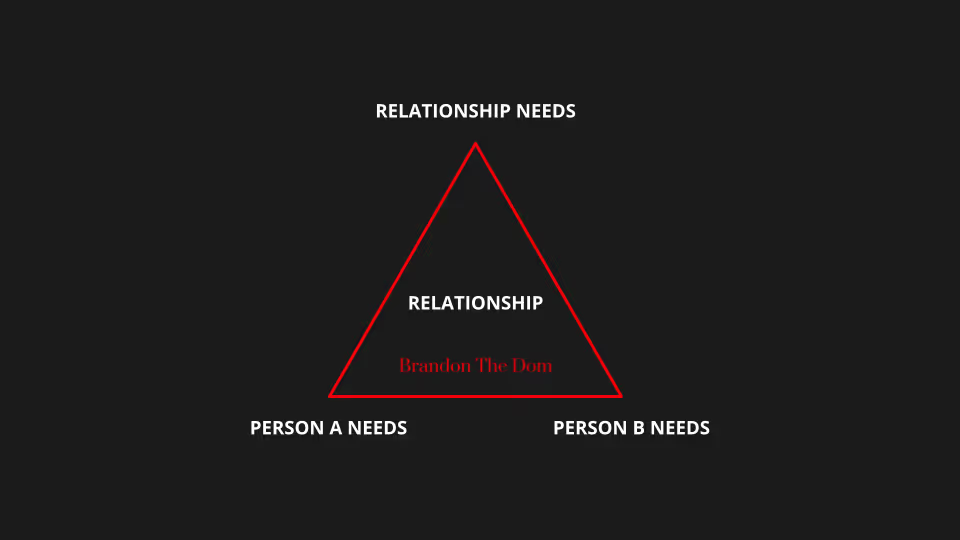
In an egalitarian relationship, both people are primarily responsible for themselves and therefore retain power over themselves. They are also jointly responsible for meeting the needs of the relationship.
In a Dom/sub relationship, the Dominant assumes greater responsibility for all three components—and is therefore given more power in order to meet that responsibility.
One of the primary obstacles to engaging in power exchange is the widespread cultural belief that people in intimate relationships should be “equal.”
Equal in dignity and respect does not mean equal in power. In a power-exchange relationship, power is intentionally distributed unequally, while equity is maintained by ensuring that both participants’ needs are fairly addressed, accounted for, and fulfilled within the exchange.
In reality, relationships between human beings cannot practically be equal without stripping away the traits that make each person unique. If you were seeking intimacy, would you choose a “relationship” between interchangeable, identical cogs?
Of course not. You’re seeking someone who can recognize your deepest needs and desires—or at the very least respect them and give them a meaningful place within the framework of the relationship.
I would argue that this principle of power exchange actually enhances autonomy, precisely because people enter these relationships through a process rooted in personal choice: a consensual agreement to meet one another’s needs, especially the rough-around-the-edges ones we might never reveal to anyone else.
A well-negotiated D/s relationship provides a secure base from which both partners can explore their emotions, desires, and personal growth. Structure and expectations, when offered with care, can deepen trust and stability—which is why many people in power-exchange relationships report feeling more emotionally grounded.
If you’d like to explore this further, I highly recommend reading my article 10 Hidden Benefits of a Dom/Sub Relationship (Beyond Just Hot Sex), which sheds light on why D/s relationships are among the most erotically charged and deeply intimate dynamics you can experience—and offers additional insight into why people choose to engage in them.
Why Would Someone Give Over Power?
First, let’s address why someone would willingly give power over themselves to a Dom—sometimes even to the point of becoming a slave.
The simple answer: the Dom cares.
Let’s take a step back for a moment. Think about your childhood. Unless it was entirely traumatic, there were times when you were willing to let your parents have authority over your life because you trusted that they had your best interests at heart. You believed they cared about you.
A submissive’s choice to surrender power is not about weakness—it’s about deep trust and emotional safety. It’s the desire to give yourself to someone who will put your well-being first; someone who will care for you when you are most vulnerable, when you have an utter lack of control. It’s the experience of being so loved and so desired that another person willingly takes responsibility for protecting you and keeping you safe.
Earlier, I mentioned that all of us hand over control of our lives to other people every day. We do this because we believe the other party—whether an employer, a corporation, or a government—will benefit us in some way. Most often, we do it so we don’t have to worry about the logistical challenges of meeting our basic needs.
So is it really that far-fetched to willingly give up control in order to have your mental and emotional needs met as well—especially when you know the other person genuinely cares about you?
In submission, you get to feel:
- Free
- Safe
- Desired
- Important
- Appreciated
- Accepted
- Loved
For many submissives, the dream is this: as long as they do what their Dom says, everything will be okay. They don’t have to make decisions. They don’t have to carry responsibility for outcomes. They don’t have to worry—about anything.
It’s liberation. Freedom from anxiety, uncertainty, and the relentless pressures of daily life—while still being cared for and taken care of.
Submission allows the sub to enter a state of tranquility and fully sink into the pleasure of a fantasy realm—a protected bubble without stress or pressure—recharging their mental, emotional, and even spiritual batteries so they can face the rest of life renewed.
That said, the submissive is not simply dumping all of their problems onto their Dom. We’re problem solvers, not charity workers. The more control a submissive relinquishes over their life, the more they are expected to serve their Dom in the way the Dom sees fit. That is the exchange.
Why Would Someone Want Power?
This is the trickier question: why would someone want that power—especially when it comes with such heavy responsibility?
Recall what I said earlier about power. At its core, power is the ability to act freely—when you want, how you want—without external forces dictating your choices. It’s the capacity to take a vision in your mind and turn it into reality without restriction or interference.
At the end of the day, the only thing you truly control is yourself. There is so much outside our control that it’s almost laughable—and a minor miracle that we manage to accomplish anything at all.
For someone with dominant inclinations, the desire for authority comes from this truth: the more aspects of life you can responsibly bring under your influence—including the relationship itself—the greater your ability to bring your vision into reality.
The real question, then, is this: a vision for whom?
Ideally, the desire for power comes from a place of servant leadership—taking responsibility for everyone’s needs, desires, and goals, and using authority to help fulfill them. In this frame, power becomes a tool wielded in service of both partners and the health of the Dom/sub relationship. The Dom’s desire for power is rooted in doing what is best for both people.
This is true for many Dominants. Structuring, guiding, and setting direction for another person can evoke a deep sense of purpose. The trust, devotion, and confidence a submissive places in their Dom is empowering. You feel their admiration, respect, and ultimately their love.
That feeling makes me feel like I can slay dragons. It fuels my soul and gives me the energy to wake up the next day and continue doing the hard work of making us both better people.
Of course, all control is ultimately an illusion. In a Dom/sub dynamic, you can only take control of two things:
- That which you can realistically take responsibility for, given your skills and capacity. Taking more than that leads to tyranny, disappointment, or harm.
- That which your partner freely and genuinely wants to give. Control without consent is manipulation and abuse.
This means that even in a Dom/sub relationship, there will always be dozens of factors outside your control. And at the end of the day, you never truly own or control another person—unless they choose, again and again, to give themselves to you.
When Seeking Power Goes Awry
What we often remain wary of are so-called “fake Doms”—people who want power without responsibility. They wield authority solely in service of their own desires and benefit. In these cases, the desire for power devolves into tyranny.
Predatory behavior—marked by exploitation, manipulation, and abuse of a power imbalance—is not the foundation of healthy power-exchange relationships. The core problem is not the existence of a power imbalance itself, but rather the motivations of the individuals involved and how the dynamic is structured around informed consent.
To help clarify the difference between consensual power exchange and potentially unhealthy or abusive dynamics, it’s useful to make some clear distinctions.
Consensual Power Exchange
- Based on enthusiastic consent
- Clear and honest about intentions
- Open discussion of needs, desires, boundaries, and limitations
- Consciously constructed dynamic with input from both people
- Encourages self-awareness and independent thinking
- People feel safe speaking up
- Encourages assertiveness, disagreement, and boundary-setting
- Shared vision and values that create mutual fulfillment
- Access to diverse knowledge sources and a network of support
- Accountability for mistakes
- Supports the growth of both the relationship and each individual
Unhealthy Dynamics
- Based on coercion
- Deliberately vague or hidden intentions
- Discourages or avoids communication about needs
- Imposed, cookie-cutter dynamic with little or no input
- Reinforces the idea that only one perspective is valid
- Fear that speaking up will lead to harm, judgment, or punishment
- Discourages assertiveness around needs and boundaries
- One-sided fulfillment rooted in selfishness
- Isolation from outside influences
- Lack of accountability for mistakes
- Supports the growth of only one person
Sometimes the line between these two categories can become blurred, depending on the activities being agreed upon. Kink educator Vahavta refers to these situations as Dark Dynamics—relationships that intentionally incorporate heavy elements such as consensual non-consent (CNC), degradation, humiliation, or the deliberate imitation of abuse cycles. These dynamics can make it more difficult to distinguish “healthy” from “unhealthy” at a glance.
That said, the key distinction remains informed consent. Both people must understand what they are entering into, and both parties’ needs must be met—even when those needs involve intense or dark experiences.
Vahavta offers a series of resources to help assess the health of a dynamic, but one of the most important questions you can ask yourself is simple: How is this dynamic affecting your life?
How to Start a Power Exchange Relationship
As you’ll soon see, starting a power-exchange relationship is a significant undertaking. That said, I’m going to walk you through the process step by step, using examples, questions, and exercises to help ensure you actually get what you want out of the relationship.
Step 1: Understand Your Core Four
I refer to the foundational elements of relationships as the Core Four: needs, desires, boundaries, and limits.
Many conflicts in relationships arise because one or more of these areas has been neglected. Too often, people remain silent, expecting their partner to “just know” what they need or want.
Even worse, some people sacrifice their own boundaries and limits in an attempt to meet their partner’s needs—without receiving any real reciprocity in return.
This is where a toxic pattern known as the covert contract emerges:
“I’ll do X for you, and in return you’ll do Y for me… but I won’t tell you what Y is—or even that I expect it.”
Covert contracts are a recipe for resentment. They lead to bitterness, emotional disconnection, and eventually contempt. As the saying goes: hurt people hurt people.
Healthy power-exchange relationships eliminate covert contracts entirely. They require overt, explicit communication about needs, desires, boundaries, and limits. A D/s relationship cannot exist without negotiation and mutual agreement.
At first glance, this level of structure and formality may seem excessive. But the truth is simple: every relationship already has an agreement.
The real question is this: Do you actually know what you’re agreeing to?
Needs and Desires
The first pair you need to understand for yourself is needs and desires.
Needs are core emotional, physical, or psychological requirements that must be met for a person to feel safe, fulfilled, and secure within a relationship. These are not arbitrary preferences; they are non-negotiable requirements for regulating the nervous system. When needs go unmet, the relationship cannot remain healthy.
Desires, by contrast, are wants, fantasies, or preferences that add excitement, pleasure, and novelty to a relationship. They enrich the connection, making it more playful, passionate, and alive—but they are optional compared to needs.
As you can see, needs should always be prioritized. That said, desires often illuminate how you would like your needs to be fulfilled. When entering negotiations around power exchange, it’s important to speak up for both.
Here’s a simple example of the relationship between needs and desires:
- Need: Shelter
- Desire: A single-family home
Understanding this distinction makes it easier to negotiate and find compromises with your partner—compromises that still meet everyone’s needs, even if the method of fulfilling them looks different.
Personal values often function as particularly strong needs—so strong, in fact, that we organize our lives around them. At times, we may even assume that others share these same needs and should live by those values as well.
Here are a few examples of how values, needs, and desires can relate to one another:
- Value: Autonomy and sovereignty
- Need: Non-monogamy
- Desire: Specific relationship structures
- Value: Autonomy and sovereignty
- Need: Income
- Desire: Entrepreneurship
- Value: Honesty
- Need: Open and direct communication
- Desire: One-on-one communication in person, when possible
Most people have at least some awareness of their needs—though they may not always be willing to admit them to themselves. Below is a non-exhaustive list of common needs to consider when reflecting on relationships.
Common Emotional and Relational Needs
- Security: Feeling safe and stable, both physically and emotionally
- Trust and honesty: Being able to rely on your partner and trust their word
- Communication: Openly and honestly sharing thoughts and feelings
- Affection: Receiving physical and emotional expressions of care
- Intimacy: Feeling close and connected, both emotionally and physically
- Validation: Feeling seen, acknowledged, and understood
- Acceptance: Being loved and accepted for who you are
- Empathy: Mutual understanding and emotional attunement
- Appreciation: Feeling valued and recognized for your contributions
- Support: Knowing your partner is there during difficult times
- Autonomy: Maintaining a sense of self and individual interests
- Respect: Being treated with consideration and having your opinions valued
- Personal growth: Having space and encouragement to grow as an individual
- Shared experiences: Creating memories and engaging in activities together
- Commitment: Feeling invested in the long-term health of the relationship
Common Physical Needs
- Physical safety: Feeling secure in your physical environment
- Sexual intimacy: Having a healthy and fulfilling sexual connection
Common Psychological Needs
- Feeling wanted and desired
- Financial stability
- Feeling needed and valued
- A sense of purpose and shared direction
- Space and independence
- Forgiveness and repair after conflict
- Contribution: Feeling you meaningfully add to the relationship
- Intentional love: Actively expressing care, affection, and presence
When it comes to desires, consider how you would prefer your needs to be met. Ask yourself: if you could have everything exactly the way you wanted, what would that look like? Then ask a second, equally important question: what alternatives would still feel acceptable, even if they aren’t ideal?
This clarity is what allows power-exchange negotiations to be honest, flexible, and deeply satisfying—rather than rigid or resentful.
Related: If you’ve ever known exactly what you want—but had no idea how to say it without killing the moment—this is for you. The Assertive Desires Masterclass teaches you how to ask for what you want clearly, confidently, and without apology—so your desires are met with interest, not resistance. Learn more here.
Boundaries & Limits
The second pair to examine is boundaries and limits. Although these terms are often used interchangeably, they are not the same.
Boundaries protect your physical, emotional, and psychological well-being. They signal what you will do to protect yourself when a line is crossed. Boundaries prevent others from imposing their will on you or pushing you outside your values. It is your responsibility to set, maintain, and consistently uphold your boundaries.
Limits, by contrast, define the edges of what you are willing to do—and how far you will go—to meet another person’s needs. They communicate what you do and do not consent to. Limits protect your time, energy, and resources from depletion, allowing you to give and receive enthusiastically rather than overextending and burning out. It’s your responsibility to set your limits, and the other person’s responsibility to listen to and respect them.
Just as needs and desires are related, boundaries and limits also work in tandem. Most often, boundaries are set around limits—so that if someone crosses a limit (their action), you have a built-in response in the form of a boundary (your action).
Here’s a non-sexual example to illustrate how limits and boundaries operate in daily life.
A common workplace limit might be: “Please contact me only via work email—don’t call my personal phone.”
A corresponding boundary could be: “I won’t answer the phone if you call me.”
Another boundary might be: “I only respond to emails in the afternoon,” which protects your mornings for focused work before tending to others’ needs.
Here are a few examples specific to power-exchange dynamics:
- Limit: You will engage in impact play up to a pain level of 6.
- Boundary: If the other person exceeds that threshold, you will reconsider playing with them in the future to protect your physical safety.
- Limit: You will take responsibility, as the Dominant, for specific areas of the relationship.
- Boundary: If the other person asks you to control areas you are not comfortable taking authority over, you will renegotiate—or end—the relationship to protect your mental bandwidth.
- Limit: Non-monogamy is acceptable, but not with your friends.
- Boundary: If the other person begins a relationship with a friend, you will either end the romantic relationship or step away from the friendship in order to protect your emotional safety and the integrity of those connections.
As a beginner Dom or sub, you may not yet know what all your limits are—and that’s completely normal. If you feel unsure about any activity, it’s essential to voice your concerns and apprehensions openly with your partner.
One helpful way to navigate this uncertainty is to categorize limits as hard limits or soft limits:
- Hard Limit: A firm no. This activity is completely off-limits and non-negotiable.
- Soft Limit: A cautious maybe. This activity is generally off-limits, but could be explored under very specific conditions, with detailed negotiation and explicit consent from everyone involved.
A particularly useful tool for clarifying limits is a sex menu—a communication aid that lists a wide range of sexual and BDSM activities and allows you to rate each one based on your interest or comfort level. Sex menus help you clearly communicate desires, turn-ons, and boundaries.
Common categories include:
- Hard Limit
- Soft Limit
- Try It
- Occasionally
- Indifferent
- Love It
- Need It
Here’s a free sex menu created in Google Sheets that includes over 350 kinky sex acts for you and your partner to rate and discuss. Use it to improve communication and create a more satisfying, connected sex life!
You can begin discovering your limits by:
- Researching different kinks and sexual activities
- Observing Doms and subs at dungeons or play parties
- Talking with someone you trust who is active in the lifestyle
- Fantasizing about various BDSM scenarios
- Exploring kinks on your own (for example, self-bondage)
- Carefully and gradually experimenting with a trusted partner
As you continue exploring, your limits may evolve—and that’s normal. Regular check-ins with your partner are essential to ensure your limits remain aligned and to discuss any new ones that arise. This is where sex menus become especially valuable: they’re easy to update as you gain experience and clarity.
When it comes to boundaries, many people attempt to set them by trying to control someone else’s behavior—saying things like, “You’re not allowed to do X, Y, or Z.” These boundaries often fail because they rely on another person changing, which is always outside your control.
They can also breed resentment. When someone feels constrained or told who they can or cannot be, their sense of autonomy may be threatened. Unless they genuinely want the same change for their own reasons, resentment tends to accumulate over time.
Instead of attempting to dictate another person’s behavior, ask yourself: How can I set a boundary that relies on my behavior instead of theirs?
Returning to the texting example, rather than saying, “Don’t text me during work hours,” a more effective boundary is: “I silence my phone during the workday and check messages at set times.” This is a boundary you can reliably uphold because it is entirely within your control.
A helpful framework for this process is Multiamory’s SELF boundary-setting tool:
- S – Search: Look for recurring situations from your past that caused distress. Identify patterns you want to change. Journal at least three significant experiences.
- E – Empower: Brainstorm boundaries that would make you feel safer or more stable in those situations. Ensure each boundary is fully enforceable by you.
- L – Live It: Apply the boundary in real life. Share it when appropriate. Observe what happens and journal your experiences.
- F – Follow Up: Refine the boundary as needed. Identify gaps, redefine it if necessary, and reflect on how to make it more effective.
You may have noticed that I often frame boundaries as:
If (their action) happens, then I will do (my action), to protect (my need).
Not every boundary fits this structure, but when it does, I find it deeply empowering. I may be biased—being a Dom—but the more responsibility I can take without trying to control someone else, the better I feel.
Step 2: Design the Dynamic
Now that you understand your needs—and have clarified your Core Four for a healthy, fulfilling relationship—it’s time to design a dynamic that can actually deliver on them.
Think of the dynamic like a ship: the Dominant is the captain, the submissive is the first mate, and the dynamic itself is the vessel that carries them toward a life where those needs are met.
For that journey to succeed, you must first build the ship and then set its course. In practical terms, this means creating a clear vision for the relationship and intentionally designing a dynamic that is most likely to get you there.
Where Is the Dynamic Headed?
Begin by asking yourself why this power exchange should exist at all—and what you hope it will fulfill in your life.
The following questions can help clarify that vision:
- Why do you want to be in a D/s dynamic?
- Why is it worth it for you to take on leadership and responsibility for a submissive?
- Why is it worth it for them to submit?
- How will this dynamic benefit each of you?
- How good could this relationship become if you both fully committed to it?
Your vision does not need to be grand or permanent. It might be as simple as, “I want a consistent partner I can rely on for sex and companionship each week,” or as ambitious as, “I want to commit to building a lifelong bond with one person.” Both are equally valid—so long as both partners consciously choose the same direction.
What Does the Dynamic Look Like?
Once you have a sense of where the dynamic is headed, it helps to develop a general picture of what your ideal power exchange looks like.
You can start with broad questions such as:
- What does each person want and expect from a D/s dynamic?
- What does Dominance mean to you, and how does it show up?
- What does submission mean to you, and how does it show up?
From there, it’s often more useful to examine specific parameters of the dynamic. Returning to the ship metaphor, these are the materials you choose to build with.
Consider the following dimensions:
- Casualness: Is the power exchange limited to the bedroom, or does it extend into everyday life?
- Time commitment: When and where is the dynamic observed? Is this situational, scheduled, or 24/7?
- Romantic involvement: What level of emotional or romantic connection exists?
- Sexual involvement: How central is sex to the dynamic?
- Relationship structure: Is the relationship open, closed, or something in between?
- Protocol: How rule-heavy is the dynamic? Are rituals and protocols strict or flexible?
- Discipline: How much accountability, correction, or behavior shaping is involved?
- Obedience: How strictly is the submissive expected to follow commands, and how much bratting is acceptable?
- Service: What types of service might the submissive provide?
- Management: How much oversight or micromanagement does the Dominant exercise?
- Activities: What practices—such as bondage or S/M—are included? (A sex menu is especially helpful here.)
- Visibility: How open are you about the dynamic with others?
- Collaring: Will collars be used, and what do they signify?
Areas of Authority
Next, consider which areas of life the Dominant may have authority or decision-making power over.
Possible areas include:
- Health
- Diet and fitness
- Appearance and grooming
- Behavior
- Self-improvement
- Skill-building
- Communication
- Service
- Finances
- Sex
- Career
- Public image
- Hobbies
- Other relationships
Some of these areas may feel exciting to surrender or take control of; others may feel uncomfortable or completely off-limits. That’s normal—and entirely okay.
Resource: This menu is used to begin negotiating areas of authority for a power exchange relationship. The purpose is to think through each area and discuss the submissives limits for giving control of that area, and the Dominant's expectations when given control. This free, easy to use template features 150+ kinky areas of authority you can rate, make notes, and share with your partner!
Non-Negotiables, Compromises, and Bonus Points
The final lens I recommend using is one of non-negotiables, compromises, and bonus points.
Clearly naming what you want is a double-edged sword. On one hand, it gives you direction and helps you discern compatibility. On the other, if taken too rigidly, it can leave you searching for unicorns—fantasy partners no real human could ever live up to.
The truth is that every relationship involves negotiation and compromise. Even when guided by strong values, trade-offs are inevitable. In an ideal world, every value would be perfectly met. In reality, we prioritize what matters most.
The same applies to power-exchange relationships. You’ll need to decide:
- What is non-negotiable for you
- What you are willing to compromise on
- What would be nice to have, but isn’t essential
One important note: the smaller your list of non-negotiables, the larger your pool of potential partners. At the same time, the clearer you are about what you want, the more likely you are to create a relationship that truly fits you. As with most things, balance is key.
Create a list with three columns: Non-Negotiables, Willing to Compromise, and Bonus Points.
Here are some categories you might consider:
- Monogamy vs. non-monogamy
- Roles
- Libido
- Children
- Marriage
- Money, career, and financial habits
- Life plans
- Lifestyle preferences
- Career priorities
- Personality traits
- Political beliefs
- Spiritual beliefs
- Core values
- Location
- Specific kinks
- Risk tolerance
- Shared activities
- Physical traits
- Shared interests
Any of the parameters discussed earlier may also fall into your non-negotiable category.
Knowing these things makes it far easier to answer the question “What are you looking for?” when seeking a partner—and, more importantly, prepares you to negotiate a power exchange that is intentional, aligned, and sustainable.
Step 3: Draft Rules & Code of Conduct
Now that you’ve established a direction for your dynamic and understand its needs, it’s time to define how you’ll get there. In other words: How does each of us need to behave in our respective roles in order to fulfill the goal we’ve set?
A Code of Conduct lays out the specific behaviors for both partners—not just the submissive. Remember: master yourself before you master another person.
A Code of Conduct might include:
- Commands: Direct, immediate statements from the Dominant that take first priority. Commands supersede assignments, protocols, rituals, and rules. The submissive is expected to drop everything and comply.
- Assignments / Tasks: Specific tasks issued by the Dominant to improve the dynamic or train the submissive. These are often one-off or short-term actions that don’t warrant becoming a formal or ongoing protocol, ritual, or rule.
- Protocols: Not to be confused with the overarching “Protocol” structure, these are if/then scenarios that temporarily modify existing rules or rituals. Example: “If among vanilla friends, I will not use honorifics.” Protocols apply only within that specific context.
- Rituals: Routines designed to enhance the emotional and psychological aspects of the relationship. Rituals create meaningful moments, reinforce the dynamic, and deepen the bond between Dominant and submissive.
- Iron Rules: Foundational, formal, and concrete directives that rarely change. These serve as anchors for the submissive’s behavior and represent the most unshakable duties of their role.
This hierarchy provides both flexibility and stability. Iron Rules form the unchanging foundation—the submissive knows that following them will always make the Dominant proud. Commands, on the other hand, are fluid, situational, and temporary. They allow the Dominant to steer the dynamic in real time and override other rules when necessary. For instance, a protocol might override a rule in a specific situation, while a command overrides everything—because in that moment, the Dominant knows what best serves the dynamic.
Start Simple
When creating a Code of Conduct, keep this in mind: keep it simple. Dead simple.
The more complicated the structure you create at the beginning, the harder it will be for you to uphold as the Dom, and for them to follow as the submissive. As a result, the structure can quickly become overwhelming, a hassle, and ultimately meaningless. You’ll both hate it and want to abandon the process before it’s even begun.
Make it easy to remember and easy to implement. Start with one simple rule—such as, “I will always listen to commands and guidance given by Him”—and implement and master it before adding another.
Addressing Needs in the Dynamic
Many people—not just submissives—carry the belief that having needs makes them a burden. For some, being of service becomes a way to feel worthy of having those needs acknowledged, if they’re acknowledged at all. While this instinct can seem noble, it often stems from a place of low self-worth. Service becomes a shield against the fear of taking up space. And in taking care of everyone else, the submissive may neglect themselves entirely.
Let me be very clear: every person has needs, and you don’t have to earn the right to have them met. Needs are not selfish. They are human.
As a Dom, part of your responsibility is to be proactive in tending to your submissive’s well-being—especially because submissives rarely voice their needs directly. While a brat will demand your attention, a service sub might quietly suffer. It’s up to you to notice.
One helpful framework for understanding how needs are prioritized in a D/s dynamic is a modified Hierarchy of Needs—not to imply importance, but rather to establish a flow of responsibility and structure.
The Hierarchy of Needs:
- Your Own Needs (Dom & sub): To create a healthy dynamic, both parties should do their best to meet their own basic needs before expecting a partner to fulfill them. D/s should come from wholeness, not scarcity.
- The Submissive’s Needs: Because the submissive is giving up control, it is your responsibility as the Dom to ensure their core needs—safety, care, emotional regulation—are protected. This is non-negotiable.
- The Dominant’s Needs: Once the submissive’s essential needs are secure, their focus shifts to serving the Dominant’s needs. These are what allow the Dom to show up fully in the relationship.
- The Dominant’s Wants: These are not critical, but they are priorities. Fulfilling a Dom’s desires (once needs are met) is part of the service role and keeps the dynamic alive and personal.
- The Submissive’s Wants: If all other levels are being cared for, then the submissive’s wants—things they’d enjoy but don’t need—can be honored and included, rounding out a fulfilling and reciprocal exchange.
This framework of needs should help you to create the right balance in your dynamic that addresses needs as you begin creating rules.
Dominant Pledges
In my own dynamics, I prefer to frame the Dominant’s conduct as pledges of responsibility—the actions and behaviors the Dom commits to in order to make the submissive’s surrender possible.
Remember, this is an exchange. This is where the Dominant is outlining what they are giving in the relationship and what they take responsibility for.
Example pledges:
- I pledge to take responsibility for myself—becoming the best version of myself mentally, emotionally, physically, and sexually—to be the best leader and partner I am capable of.
- You are my submissive, and I pledge to respect you as an individual and honor your agency.
- I pledge to take responsibility for leading the relationship and making decisions.
To start, pledge only the responsibilities you’re actually capable of taking on. Don’t overburden yourself. It’s far better to commit to one responsibility and knock it out of the park than to promise the world and underdeliver.
Submissive Rules
For the submissive, the Code of Conduct is typically more expansive. I will use the framework of rules, rituals, protocols, tasks, and commands. For the sake of this article, we will only focus on rules.
There are several ways to approach creating service rules, but what I don’t recommend is assigning meaningless rules—unless they’re used deliberately as punishment. The entire point of submission is that the act itself is infused with meaning.
Instead, choose rules that bring the fulfillment both of you are seeking, even if they appear mundane from the outside. Even the simplest act can become a powerful gesture of devotion.
Take the example of a submissive fetching water. On the surface, it’s a basic task: she brings the Dom a glass of water. But with each repetition, the act can be layered with intention and ritual. The second time, she asks, “Sir, may I get you some water?” The third time, she brings the glass and adds, “May I get you anything else, Sir?” The fourth time, she kneels before presenting it. Bit by bit, the act transforms from routine assistance to a devotional ritual. Each iteration deepens the D/s dynamic.
A great place to start is mutual brainstorming. Each person explores the dynamic from their own position, identifying rules that feel meaningful.
As the Dom, I begin by asking myself a few key questions:
What’s annoying for me to do? One of the biggest failure points in creating rules is when a Dom designs ones that sound sexy in theory—but in practice, they’re impractical, inconsistent, or unsustainable. You might forget to enforce them, or stop caring whether they’re done.
But when you assign rules that actually relieve you of things you find frustrating or tedious, you’re far more likely to notice when they’re incomplete—and stay invested in holding your submissive accountable. Plus, by delegating those tasks, you free up time and energy for higher-priority aspects of the dynamic.
What would improve the relationship? Some tasks simply make the D/s dynamic run more smoothly. For example: keeping the contract updated, sourcing new scene ideas, or planning logistics for dates and play sessions. While the Dominant should be making the final decisions, the submissive can often do the research, generate ideas, and handle implementation. That’s not just service—it’s strategic partnership.
What would make me feel cherished? Some rules are entirely indulgent, and that’s okay. What matters is that they nourish you. For example, I love receiving massages—not just because they feel good, but because I push myself hard at the gym. Having someone tend to my sore muscles isn’t just physical care; it makes me feel seen, supported, and cared for.
While I’m doing my own reflection, I’ll also ask her to consider:
- What goals do you want to focus on?
- What strengths or skills do you have that might be useful to me?
- What kinds of service excite you?
- What types of service would you never want to provide?
- What would feel terrible or draining if you had to serve me that way?
These questions help me assess her talents, her internal motivations, and her limits.
Yes, the submissive can learn new skills to fulfill assigned duties—but I find it’s often more sustainable to start with what she’s already great at and enthusiastic about. That said, not every rule will be fun. Some will suck—because that’s their nature. Others might be challenging to learn. But if the rule brings deep meaning to the Dom or fosters powerful growth in the submissive, it may still be the right one.
Review
Sit down with your submissive and review the drafted Code of Conduct.
Discuss:
- Why each pledge or rule exists and how it serves the dynamic
- How you want each responsibility to be observed
- What the consequences are if a rule or responsibility isn’t upheld
- Where either of you might realistically struggle with implementation
If conversations like these are difficult for you, I recommend looking over my How to Have Difficult Conversations guide.
Make sure you're both genuinely on board with the structure. If anything feels off, adjust it now—before it becomes something you both resent or simply ignore.
Step 4: Implement
This is where the rubber meets the road. You’ve formed a hypothesis about what might work for your dynamic—now it’s time to test it out in the real world.
A quick heads-up: it probably won’t work perfectly. At least not right away. That’s okay! This is experimentation. You’re learning together what works and what doesn’t. Don’t let early struggles discourage you. It’s all part of the process.
Implementation often reveals:
- What values you share—or discover you don’t
- How you communicate and negotiate under pressure
- New turn-ons or turn-offs you hadn’t anticipated
- Protocols you need in special scenarios (e.g., around friends or family)
- Rituals that bring you closer and fit naturally into your lives
As you uncover more about yourselves, each other, and what your dynamic actually requires, you can evolve your structure. I recommend keeping a living document that you update regularly. Over time, this document will naturally become your Dom/sub contract.
Submissive Training
Like any habit or routine, implementing new behaviors and ways of being requires consistent effort from both partners.
Some Dominants prefer to create structured training schedules where the submissive learns the entire Code of Conduct in an intensive session over a few days. This allows them to understand the full scope of their training goals before gradually implementing each new duty over the following weeks.
For example, let’s say you followed my recommendation to start minimally when creating rules, rituals, and protocols. You decide to begin with three rules, one ritual, and one protocol, with a contract term of one month.
Your training schedule might look like this:
- Days 1–2: Teach the submissive everything—the rules, ritual, and protocol—along with the expectations for accountability if they’re not followed correctly.
- Week 1: Focus solely on Rule 1, holding them accountable only for that rule.
Week 2: Introduce Rule 2 and hold them accountable for Rules 1 and 2. - Week 3: Add Rule 3 and hold them accountable for Rules 1, 2, and 3.
- Week 4: Introduce the ritual and protocol, holding her accountable for all the rules as well as the new additions.
- Day 31: Revisit the contract and make adjustments as necessary—adding, refining, or removing elements of the Code of Conduct for the next training period.
This schedule can be adapted for any length of time and any number of duties. The initial intensive serves to establish clear expectations, test out the new structure, and give both partners a reference point for what they’re working toward. Breaking the process down gradually prevents overwhelm and makes each new behavior easier to integrate.
When paired with weekly check-ins, this training method becomes even more effective. During these sessions, the submissive can share feedback about the structure, challenges, and emotional responses they’re experiencing. The Dominant can then use that information to make thoughtful adjustments to the rules or training plan as needed.
Correcting Mistakes
I highly recommend avoiding harsh punishments during this initial phase. Honestly, you’re both likely to fumble a bit. You’re trying on new roles, habits, and ways of relating to each other—and that takes time and practice. Be patient. Offer grace.
For submissives, the emotional toll of a misstep can be immense. These are often high-achieving, self-critical people who take pride in their performance—so even small mistakes can trigger guilt, shame, or a sense of failure.
That’s why correction doesn’t require punishment so much as atonement—a way for them to repair trust and reset their sense of purpose. The psychological weight of disappointing their Dom is often heavier than any punishment you could issue.
Here’s how I handle correction:
- Acknowledge the mistake calmly and directly. No drama.
- Explore the cause together—curiously, not critically.
- Make a plan to avoid it happening again.
- Reassess whether the task is aligned with the sub’s skills or support needs.
If the issue is behavioral (not just a one-off mistake), then a more structured consequence or punishment may be needed—but always with the goal of growth, not shame.
That said, accountability still matters. To hold your submissive accountable, I recommend using the Accountability Triangle: rewards, punishments, and feedback.
Quick warning: If your only tool for discipline is punishment, you’re already losing. This masterclass teaches you how to shape behavior, reinforce what works, and eliminate resistance—without damaging connection. Learn the system here.
Rewards
In a D/s dynamic, a reward is a method of reinforcing a submissive’s behavior when they excel at following the mutually agreed-upon rules established by the Dominant. When a submissive follows a rule—and especially when they go above and beyond in their service—the Dominant uses a reward, often something the submissive truly enjoys, to encourage positive behavior, strengthen obedience, and boost confidence.
I cover rewards in greater detail—with examples—in BDSM Rewards for Submissives. For now, here are the key principles to remember:
- Balance internal and external motivation. As much as possible, tap into your submissive’s internal motivation to serve before relying on external rewards.
- Make sure the reward is something they want. For a reward to be effective, it must be genuinely desired. Since every submissive is different, rewards should be personalized.
- Give rewards enthusiastically. Seeing their Dominant light up with pride and joy can be a reward in itself. Nothing is more demoralizing than having thoughtful effort brushed off.
- Let them know potential rewards in advance. Just like punishments, rewards work best when the submissive knows what they’re working toward. Understanding incentives helps them put in extra effort—especially for less enjoyable tasks.
- Explain why they are being rewarded. Before giving the reward, be clear about what specific behavior earned it. This reinforces that you notice and value their effort, while also deepening appreciation.
One of the most frequent and effective rewards is verbal praise. Performance-based praise is valuable for reinforcing specific behaviors, but I also encourage you to use intimacy-deepening praise—the kind that celebrates who they are, not just what they did. This kind of praise helps your submissive feel seen, cherished, and proud of their identity in the dynamic, not only their actions.
Punishment
In a D/s dynamic, punishment is a method of correcting a submissive’s behavior when they violate mutually agreed-upon rules established by the Dominant. When a submissive breaks a rule, the Dominant uses a punishment—something the submissive dislikes but is still within their limits—to correct behavior and discourage future transgressions.
I’ve covered punishments in greater detail in my BDSM Punishments for Submissives guide.
To recap, the core principles of punishment are:
- Check yourself first. Before punishing your submissive, evaluate your own role in the transgression. While the submissive is responsible for following the rules, the structure of the dynamic may require adjustments to prevent repeat issues.
- The punishment should match the crime. The severity of the punishment should align with the severity of the misdeed.
- Let your submissive know the punishments in advance. Just as society operates with known consequences for breaking laws, your submissive should be aware of the potential consequences of their actions. Discussing punishments beforehand ensures consent and can also serve as a deterrent.
- Be prompt in administering punishments: Discipline is most effective when delivered promptly. The longer the delay, the weaker the connection between the transgression and the consequence.
- Be firm yet understanding: Punishing a submissive can be difficult, but failing to follow through undermines the rules and expectations you’ve set. Listen to their perspective, but remain firm in upholding the agreed-upon structure.
- Explain why they are being punished: Before administering discipline, make sure your submissive understands why they are being punished. Even better, ask them to explain it to you—this reinforces accountability.
- Punish from a place of love: Never punish from a place of anger, as this risks crossing boundaries and violating consent. After punishment, take time to rebuild connection with proper aftercare. Remind your submissive that they are still valued and that their mistakes do not define them.
Need more inspiration? Download my free list of 81 Ways to Punish Your Submissive to help you get started.
A Note on Funishments
Let’s also talk about funishments. These are activities that look like punishments but are actually enjoyable, desired, and rewarding for the submissive. For example, while a spanking might feel like a punishment to some, others may find it deeply pleasurable.
Funishments are most often initiated by the submissive when they want to be cheeky or engage in brat play. While a D/s dynamic is rooted in structure and discipline, it should also be enjoyable. If your submissive delights in brat play, create space for it in a way that’s fulfilling for both of you.
Just be sure to define which punishments are “for fun” versus those reserved for serious transgressions. Without this distinction, accountability can become murky and the effectiveness of real punishment weakens. Funishments, on the other hand, can be used as rewards or as tools to reinforce the submissive mindset—for example, through maintenance spankings.
Feedback
Occasionally, I get asked what keeps the Dominant accountable. The truth is, if the Dom fails to uphold their end of the bargain, the entire structure of the dynamic collapses. Their consequence is simple: the dynamic stops working, and the submissive loses respect.
The submissive’s voice in the dynamic is of utmost importance. The clearest microcosm of this principle is the safeword. The Dominant may have planned the scene and initiated its actions, but with a single word, the submissive can stop everything.
Your voice is also the pulse of the entire dynamic. Once a mutual vision and goals are set, and the Dom gives direction, it becomes the submissive’s responsibility to provide feedback—on how intentions are being received, whether expectations are realistic, and whether the dynamic is truly serving both partners.
I always encourage my submissives to develop a deep relationship with their feelings, because those feelings act like check-engine lights on a car. The light tells you something is wrong, but not necessarily what. In the same way, feelings signal that something in the dynamic needs attention. It’s a cue for the Dominant to look under the hood and make adjustments so everything runs smoothly again.
Another reason your voice matters is because you are the only one who can advocate for your needs. The Dom sets the direction of the dynamic, so their own needs are usually built in. If you never speak up, yours may go unfulfilled. While the Dom should be checking in, it is ultimately your responsibility to ensure your needs are expressed and heard.
That’s why the submissive should consistently provide feedback. Let your Dominant know when they’re making mistakes, but also express gratitude and appreciation when they’re doing well.
That said, there is an art to giving feedback so it is well received, taken seriously, and not dismissed.
Tips for Giving Feedback to a Dom:
- Respect the rules set by your Dom. If protocols exist around communication, honor them—while ensuring they still allow space for your emotional well-being. These rules may dictate the time, place, or form feedback should take.
- Tune into your feelings while practicing emotional regulation. Identify what you’re feeling so it can be expressed clearly. Avoid using emotional intensity to attack your Dom. If emotions are heightened, it’s often best to pause until you’re both calm, ensuring the conversation is productive rather than reactive.
- Choose the right time and place. Not every situation is ideal for feedback. If your Dom is drained, your words may fall flat. If you’re at a social event, criticism may undermine their authority. In these cases, it can help to have a designated weekly time for feedback, ensuring nothing gets lost.
- Practice the art of difficult conversations. Prepare in advance, encourage emotional expression, listen to understand, and speak to be understood. Use “I” statements and principles of nonviolent communication.
- Emotionally support your Dom. Sometimes feedback will sting. If your Dom is triggered, upset, or angry, stay compassionate while still asserting your perspective. Never silence yourself to protect your Dom from discomfort—honest communication is essential for trust and growth. At the same time, avoid being intentionally hurtful. If your words cause pain, apologize sincerely.
- Seek clarity and respect the Dom’s direction. Sometimes expressing your feelings won’t require any change; other times, it will. In those cases, receive your Dom’s decisions with openness, grace, and respect. Even if you don’t fully agree, remember they are leading the dynamic and may see the bigger picture. Your willingness to listen fosters security and reinforces the structure you’ve both chosen.
Sometimes the roles and rules themselves can block something important that needs to be said. For those moments, I recommend creating a communication safeword. Much like a safeword in a scene, this word temporarily suspends protocol and power exchange, allowing you both to speak as equals.
Step 5: Adjusting the code of conduct
I strongly recommend setting a regular review interval where you and your partner check in about how the dynamic is going. You want enough time between reviews to give the structure a fair shot, rather than abandoning it during the initial growing pains. But you also don’t want to go so long that problems fester.
In my dynamic, we have a monthly relationship check-in where this is one of our core discussion points. Find a rhythm that fits your relationship.
During your review:
- Assess how well the code of conduct is working
- Identify anything that needs to be added, removed, or refined
- Talk through any new rules, rituals or protocols that have emerged naturally
- Decide what changes, if any, to implement in the next phase
Then go back into implementation mode. Test. Discover. Adjust. Repeat.
Power That Serves, Not Power That Takes
At its best, power exchange is not about dominance for dominance’s sake, nor submission for submission’s sake. It is about designing a relationship that serves both people, even—and especially—when power is deliberately unequal.
Throughout this guide, you’ve seen that healthy D/s dynamics are built on responsibility, consent, and intentional structure. The Dominant leads, the submissive follows—but both choose the path together. The imbalance of power exists in service of mutual fulfillment, not at the expense of one partner’s needs.
By working through the process outlined here—clarifying your Core Four, defining boundaries and limits, designing the dynamic, and creating a living Code of Conduct—you ensure that both partners speak up for what they need, want, and are willing to give. Nothing is left to assumption. Nothing is buried in silence. Nothing relies on mind-reading or hope.
This level of intentionality is what separates fantasy from function.
When power exchange is designed consciously, negotiated honestly, and revisited regularly, it becomes far more than kink or roleplay. It becomes a container for trust, growth, devotion, and intimacy—often deeper than either person imagined possible at the start.
Take your time. Start small. Stay curious. And remember: the most powerful dynamics aren’t the ones that look impressive from the outside—they’re the ones that quietly, consistently fulfill the people inside them.

Master the 12 essential steps to become a good Dom—build the skills, mindset, and presence of a man she respects, desires, and willingly surrenders to—inside and outside the bedroom.
Learn MoreRelated Articles

10 Hidden Benefits of a Dom Sub Relationship (Beyond Just Hot Sex)
Continue Reading
Dom Sub Contract: Structuring Your D/s Dynamic (Free Template)
Continue Reading
Building Trust in Dom/sub Relationship is a Two-Way Street
Continue Reading
