How to Create a BDSM Risk Profile (Without Killing the Fun)

Are you using a BDSM risk profile—or just hoping nothing goes wrong?
Summary:
A BDSM risk profile is a personal assessment of the physical, emotional, psychological, medical, and relational risks you're willing to accept when engaging in kink. Rather than trying to eliminate all risk, a thoughtful risk profile helps you make informed decisions, communicate your boundaries, and choose mitigation strategies that align with your values and comfort level. This guide explains how to identify and assess risks, reduce them through education and preparation, communicate your risk profile with partners, and engage in BDSM with greater confidence, responsibility, and awareness.
Unless you’re well-versed in BDSM, risk profiles are probably a foreign concept. I know they weren’t something I thought much about when I first started—especially because most vanilla people don’t communicate these kinds of considerations very well.
But as it turns out, most of us are already informally assessing risk in our heads when we make decisions. Not communicating those assessments, however, leaves unspoken discrepancies that can potentially be harmful for one or more people engaging in the dark arts together.
We might also judge another person because they appear to be doing something wrong—or feel judged ourselves—when, in reality, we simply have different risk profiles.
Most importantly, understanding the risks of what you’re about to engage in allows you to make a more informed and intentional decision about whether to participate—and whether you can accept the potential consequences of your actions.
Today, we’ll explore risk in BDSM: how to assess it based on your personal preferences and context, and strategies for mitigating it so you can engage in all the fun debauchery you can handle.
Side note: If you’ve ever thought, “Am I the only one struggling with this?” — you’re not. The Red Room is a private community where kinky people ask real questions, share real experiences, and grow without shame or posturing. Step inside here.
What Is a BDSM Risk Profile?
First, risk refers to the uncertainty that something may result in loss, injury, or another undesirable outcome. It involves both the likelihood of an event occurring and the severity of its consequences. For example, while there is a nonzero probability of a plane flying through your house—a severe consequence—the likelihood of it happening is extremely low, making it a low-risk scenario.
A risk profile in BDSM refers to an individual’s assessment of the potential risks associated with the activities they wish to engage in. This assessment weighs the potential negative consequences—physical, emotional, psychological, and relational—against the opportunities or rewards a specific BDSM activity might provide.
By making this assessment, you create a set of boundaries within which you choose to play—boundaries that you deem safe enough. And if those potential negative consequences do occur, you’ve already decided they are risks you can accept and live with.
Risk profiles are inherently individual—what feels acceptable to one person may feel far too risky to another.
Why Are BDSM Risk Profiles Important?
Consider for a moment that every day, you are exposed to risk. It only takes watching Final Destination or 1000 Ways to Die to realize how fragile our assumptions of safety can be (and maybe make you a little paranoid, too). However, we don’t sit in sterile, padded rooms and avoid the world entirely—because not all risks are high, frequent, or worth sacrificing the benefits of engaging with life in the name of safety.
You’ve been building a risk profile for life whether you’re consciously aware of it or not. Every time you make a decision—big or small—you’re calculating risk. Even though driving a half-ton chunk of metal at 80 mph could have serious consequences, you still take that risk because of the many safety precautions in place—from rules of the road to vehicle safety mechanisms—that make driving safer.
But the risk is never zero. Instead, enough protective measures are in place that you can accept that risk. And if you can’t accept it, then driving simply isn’t an activity for you.
There will always be unexpected or unpredictable factors beyond your control—drunk drivers, road rage, and so on.
BDSM is exactly the same. Just like driving, every activity carries risk—especially the physically or psychologically intense ones we find so compelling. BDSM will never be 100% safe. That’s simply a reality we have to accept every time we engage in play.
However, the goal is not zero risk. The only way to eliminate the risks of BDSM is to avoid it entirely—but then you pay the opportunity cost of missing out on the thrills, psychological integration, pleasure, and intimacy it can provide. And let’s be honest—danger is part of the fun.
Instead, the goal is to make activities safe enough through better practices, stronger preparation, and smarter decisions—so that you feel comfortable engaging and are willing to accept the worst-case consequences in the unlikely event they occur.
Creating risk profiles allows you to:
- Keep what matters most to you protected, so you never risk something you couldn’t live with losing
- Set up mitigation strategies for both minor and severe consequences
- Identify areas where you need better education
- Facilitate clearer communication with others—especially those who are more or less risk-tolerant than you
- Ask better, more precise questions of potential partners
- Prioritize which risks are most important to avoid
- Recognize when play or an interaction needs to end, rather than just “check in”
Most importantly, it allows you to have fun without living in fear—while still being responsible. And when someone suggests a risky activity, you’re fully aware of—and consciously choosing—what you’re about to engage in.
Side note: Hinting, hoping, and holding back is exhausting. If you’re ready to stop guessing and start communicating with confidence, the Assertive Desires Masterclass gives you clear frameworks for expressing desires, boundaries, and limits—without awkwardness or fear. Get instant access here.
How to Create a BDSM Risk Profile
Here’s a process you can use to better understand—and empower yourself around—risk in BDSM.
Step 1: Identify the Risks
Now’s the time to answer the question: What’s the worst that could happen?
There are two ways I want you to approach this.
The first relates to specific activities. Pick an activity you want to engage in—for example, face slapping—and list all the potential risks, both common and uncommon, associated with it.
For example:
- Perforated eardrum
- Dislocated jaw
- Chipped tooth
- Scratched or damaged eyes
- Bruising and swelling
- Head injury
- And so on…
The second approach focuses on consequences—outcomes that could result from engaging in BDSM as a whole or across a variety of activities. Identify which types of loss or injury would be too great a cost for you to endure.
Some examples might include:
- Losing a job (which leads you to consider privacy risks, filming, wearing collars at work, etc.)
- Losing a relationship (which shifts your attention to who you engage with)
- Brain injury, especially if you’re a knowledge worker
As you begin identifying risks, you’ll quickly realize you don’t know what you don’t know—meaning you’re unaware of some of the risks associated with activities you want to (or already do) engage in.
The solution is education.
Seek out resources. Read other people’s experiences. Talk with those who are more experienced. For certain BDSM activities, resources like Vahatva’s Risk Evaluation Database can give you a useful starting point for identifying potential risks.
Risk Areas
Although our brains are primarily focused on keeping us physically safe (so we don’t die), physical consequences are only one part of the picture. There are many other types of consequences we may have to live with—and should carefully consider.
Some major risk areas include:
- Physical: What injuries or harm to the body could occur? Consider both immediate damage (e.g., bruising, loss of circulation, passing out) and cumulative damage (e.g., nerve damage over time from shibari, brain injury from repeated choking).
- Medical: What existing health conditions need to be considered? Think about prior injuries, chronic issues, mobility limitations, underlying health concerns, or medications.
- Emotional: How might this type of play make you feel about yourself, the activity, or your partner? Consider both the nature and intensity of those emotions, and whether they can be experienced safely.
- Psychological: How could this affect your mental health? Consider trauma triggers, anxiety, and the effects of subspace and subdrop. Also account for cognitive processing patterns, including neurodivergence.
- Relational: How might engaging with this person impact your life or existing relationships? Not everyone is the right fit for your current circumstances—and that’s okay.
- Experience: What is each person’s level of knowledge and experience with the activity? Gaps in education can lead to unsafe discrepancies in safety practices.
- Communication: How well do you and your partner communicate? Do you fully understand each other’s needs, desires, boundaries, and limits? How transparent are you both about expectations?
- Contextual: When and where will the activity occur, and how does the environment influence risk? Consider public vs. private settings, time constraints, the physical space, and available equipment.
To help you get started, the risk assessment tool at riskinformed.org can be very helpful.
Step 2: Assess Those Risks for Yourself
Once you’ve identified the risks, the next step is to assess them.
Not all risks carry the same weight, and not all risks matter equally to every person. What feels too risky for one person may be completely acceptable to another.
For each risk, start asking yourself:
- How likely is this to occur?
- How prepared am I to handle it if it does?
- How prepared is my partner to handle it if it does?
- How severe are the potential consequences?
- Could I accept—or live with—the outcome if it happened?
A tool that can be especially helpful here is a risk matrix, which evaluates risk by comparing likelihood versus severity. Some risks may have high impact but low likelihood, while others may be more likely to occur but carry relatively minor consequences.
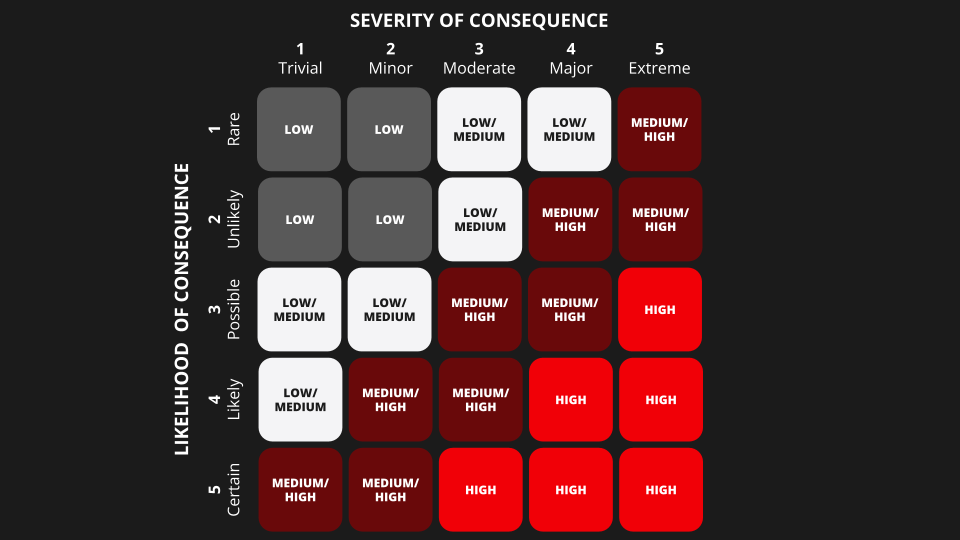
As you assess your risks, you may find activities you’re interested in—but ultimately determine they’re too risky for you right now.
When that happens, you have two options: build your capacity to handle that level of risk, or implement mitigation strategies to reduce it. Ideally, you do both.
Step 3: Build Your Capacity for Risk
A personal philosophy I live by is this: rather than backing away from challenges or opportunities, I build myself into the kind of person who can meet them.
Most often, that means acquiring the skills and knowledge necessary to rise to the occasion. In doing so, I develop deep confidence in my own competence—which makes it easier to take risks that others might avoid. At times, I’ll even deliberately place myself in difficult situations to expand that capacity.
I’m so bullish on the power of education and skill-building to transform a person’s life that it’s become part of my mission. All of my work—even beyond this space—centers around education. My D/s dynamics reflect this as well, often incorporating elements of guidance and mentorship to help my submissives become more powerful, assertive, and resilient individuals.
It matters that much to me.
Knowledge is your first line of defense against high levels of risk. Developing skills significantly reduces both the likelihood and severity of negative outcomes—and increases the chances of positive ones!
High-quality education helps you identify and avoid worst-case scenarios by deepening your understanding of anatomy, equipment, emotional dynamics, and emergency responses. It also equips you with practical techniques, clarity on when and how to apply them, and awareness of how they affect you, your partner, and the overall situation.
But hard skills are only half the equation.
The other half is developing a strong sense of internal security and self-esteem.
Much of our fear around risk comes from the stories we tell ourselves about worst-case scenarios—that if they happen, we won’t be okay. We signal to our brains that these outcomes are catastrophic, on the level of survival itself.
For example:
- If you experience intense subdrop, you won’t be able to handle it.
- If the relationship ends, you won’t recover.
- If something physically serious happens, your life is over.
Of course, we don’t want tragedies to occur—and if they do, they will be difficult. Even our beliefs about death shape how we perceive these risks.
But what we often fail to recognize is that, even after hardship, people find ways to continue living—sometimes even thriving. We adapt. We rebuild. We learn to accept life as it is.
And in most cases, those worst-case scenarios never actually happen. The consequences we do experience tend to be far less severe than we imagined. Over time, through lived experience, you begin to see a pattern: life goes on. You are more resilient than you thought. And with each experience, you're more prepared for what life throws at you.
That said, knowledge and experience comes with an important caution.
Experience reduces risk—but it never eliminates it.
No matter how skilled or experienced you become, you are still human. You will make mistakes. The belief that “I’ve done this a hundred times” does not mean nothing can go wrong.
In fact, complacency—and the failure to continue learning and refining your practices—can be more dangerous than inexperience.
Don’t fall into the trap of believing you’re impervious, or that the worst-case scenario can’t happen to you.
Step 4: Risk Mitigation Strategies
Some risks can be significantly reduced by using mitigation strategies. Risk mitigation means lowering the likelihood that a consequence will occur—or reducing its severity if it does—in order to increase overall safety.
The goal is not zero risk—because that’s nearly impossible—but rather reducing risk to a level that feels acceptable to you.
The basic process looks like this:
- Identify a risk
- Apply a mitigation strategy
- Reassess the risk
- If it’s still too high, continue mitigating
- Repeat until the risk reaches an acceptable level
Some risks, however, will never reach a level you’re comfortable with—no matter how many precautions you take. In some cases, the potential consequences simply aren’t something you’re willing to accept.
And that’s okay.
Walking away from something that doesn’t fit your risk profile is a responsible and empowered decision.
Let’s look at different types of risk mitigation strategies. I’ll present these from most effective (and most restrictive) to least effective (and least restrictive) in terms of reducing risk and increasing safety.
I’ll also distinguish between strategies you can personally implement and those that rely on a partner. Because at the end of the day, the only person you truly have control over is yourself—and no one else is obligated to meet your needs unless they’ve explicitly agreed to do so.
Elimination
The safest and most effective way to avoid a risk is… to not engage in the activity at all.
For some risks, this is the right decision. It’s not only okay—but encouraged—to have hard limits around what feels too risky for you. You have to be honest with yourself and identify where your line is. No one else can define that for you, because you’re the one who has to live with the consequences if something goes wrong.
This doesn’t apply only to physical activities. Certain relationships may also carry too much risk—whether due to emotional distress or a mismatch in values.
That said, we all remember being horny teenagers sitting through sex ed classes preaching abstinence. How well does being told not to do something work when it’s something you really want to do?
Instead of eliminating everything outright, a more practical approach is often to remove—or replace—the most dangerous elements of an activity.
Substitution
Rather than eliminating an activity entirely, you can substitute the riskiest components with alternatives that carry less risk but evoke similar feelings.
If you’ve been reading my work for a while, you’ve probably seen me talk about the practice of keeping an erotic journal. This helps you uncover the underlying emotions driving your desires. Once you understand those emotional drivers, you can identify alternative activities that create the same feelings—without requiring the same level of risk.
Let’s look at a few examples.
Choking is a high-risk activity (and if you’re not aware of that, it’s worth educating yourself). The most dangerous aspects involve restricting the airway (breath play) or restricting blood flow.
A safer alternative is a “fantasy choke,” where you place your hand around a partner’s neck without applying pressure or restricting airflow. This can create many of the same psychological and emotional effects of dominating someone without the physical danger.
If you’re interested in capture or takedown CNC (consensual non-consent) fantasies, you might begin with lighter elements—such as bondage, manhandling, and intense dirty talk—to evoke a similar feeling without introducing higher levels of physical or psychological risk.
Bondage is another strong example. Instead of jumping into rope suspension, you can start with floor-based bondage, cuffs, or even bondage tape, depending on your comfort level. Each of these can still create a powerful sense of surrender through restricted movement.
With degradation, certain words may act as emotional triggers and be off-limits. In those cases, using alternative phrasing or softer synonyms can preserve the dynamic while avoiding harm.
Isolating Hazards
Sometimes, you have your heart set on a particular activity—and substitutions just don’t cut it. Anyone who’s gone gluten-free knows that alternatives can really suck.
This is where isolating hazards comes in.
Instead of removing the activity, you identify and reduce the most dangerous elements within it. Doing this effectively requires a solid understanding of how the activity works—which means education and practice.
Workshops and video demonstrations are especially valuable here. Watching an experienced practitioner move through a process helps you understand not only how to do something, but also where the risks lie at each step. In many cases, the biggest hazard isn’t the activity itself—it’s a lack of knowledge or skill.
Once you understand the mechanics of an activity, you can begin isolating specific risks and putting safeguards in place.
Some examples include:
- Using padded or soft flooring for rope suspension
- Choosing temperature-appropriate candles for wax play
- Practicing controlled or “soft” landings during rough body play
- Supporting a partner’s head before pushing them against a wall
- Limiting engagement levels (e.g., play partner vs. deeper relationship) to manage emotional or relational risk
- Meeting or playing in public spaces rather than private ones
- Ensuring proper hydration before play
- Saying no to activities you’ve previously agreed to when you’re not in the right headspace
The common thread across all of these is preparation. These safeguards are put in place before harm or loss occurs.
Preparation doesn’t eliminate risk—but it significantly reduces it.
Codes of Conduct
So far, we’ve focused primarily on the activity itself and the context in which it occurs. But there’s another major variable in any interaction: the people involved.
And people are unpredictable.
To create more certainty, we establish norms—shared expectations for how we interact and behave with one another.
In Dom/sub dynamics, this often takes the form of codes of conduct: rules, protocols, and rituals. While many of these are designed for structure or enjoyment, others are specifically created with safety in mind. For example, having different protocols for interacting at home versus around family can help reduce social or reputational risk.
In non-monogamous relationships, agreements are often established to reduce the risk of emotional or psychological harm that may arise from outside connections.
In BDSM, we build systems that support communication before, during, and after play—helping all parties stay aligned and safe.
These include:
- Vetting: Asking questions and getting to know each other well enough to feel comfortable engaging
- Negotiation: Discussing needs, desires, boundaries, limits, and risk profiles
- Safewords: Verbal or nonverbal signals used to pause or stop play when it becomes too intense or unsafe
- Debriefs: Reflecting on what went well, what didn’t, and what should change moving forward
The limitation of these strategies—and the reason they rank lower in effectiveness—is that they place a significant portion of your safety in someone else’s hands. They require a high degree of trust, rather than relying solely on your own ability to manage your risk.
People are wild cards when it comes to safety.
So alongside these shared systems, it’s important to consider what you can do independently to eliminate, substitute, or isolate risk.
For example, you might bring your own bag of toys—items you know are clean, well-maintained, and only the ones you like playing with.
Practices like introspection and developing assertiveness will also help you communicate your needs, desires, boundaries, and limits more clearly.
Even small choices can matter. Something as simple as wearing your hair in a bun instead of a ponytail can reduce the chance of an inexperienced partner grabbing it like horse reigns and pulling your hair wrong.
Of course, safety is ultimately a collaborative effort.
Dominants are responsible for the safety of their actions. Submissives are responsible for honest communication and maintaining self-awareness. Neither role can fully outsource responsibility to the other.
Protective Equipment
This is your last line of defense.
Protective equipment and safety measures come into play when something has already started to go wrong. They are the least effective form of risk mitigation—not because they aren’t important, but because they respond to danger rather than prevent it.
These include items such as:
- Emergency plans
- Safety shears for quickly cutting rope
- Medical supplies and first aid kits
- Fire extinguishers
- A trusted contact who knows your location in case something goes wrong
- Scheduled check-ins or calls with a therapist after an intense scene
- Exit strategies for D/s dynamics
These tools are valuable and should absolutely be part of your overall risk mitigation plan. But they shouldn’t be your entire plan if your goal is to meaningfully reduce risk.
To illustrate this, consider the physical risks of sex—specifically STIs and pregnancy. Many people (including myself in the beginning!) place the majority of their risk mitigation on protective equipment. Throw on a condom, and you’re good to go.
But a condom is, at the end of the day, just a thin barrier between you and potentially life-altering consequences.
Instead, consider how you could move up the mitigation ladder:
- Codes of Conduct: Regularly share STI test results and communicate openly about sexual health
- Isolating Hazards: Use preventative measures such as vaccines, suppressive medications, birth control, or procedures like vasectomies and tubal ligation
- Substitution: Choose lower-risk sexual activities or adjust behaviors during higher-risk periods
- Elimination: Abstain from certain activities or choose celibacy when necessary
Okay, we’re probably not choosing that last one if we can help it—but it is an option.
The point is, you have far more tools available than just protective equipment. And relying solely on it leaves unnecessary risk on the table.
Step 5: Communicate Your Risk Profile
It’s very likely that anyone you engage with—sexually, kinkily, or otherwise—will have a different risk profile than you.
Because of that, communication becomes essential.
You’ll either need to adjust toward the more conservative risk profile—the person who faces greater potential consequences and therefore requires safer practices—or seek out partners whose risk tolerance more closely aligns with your own.
In my experience as a Dom or Top, I’ve spent a significant amount of time building my capacity for risk by developing skills across all the areas we discussed earlier. As a result, I often operate with a broader risk profile.
But as the person leading a scene or relationship, that doesn’t mean I get to impose that on others.
It means I have to take responsibility for clearly explaining the risks and potential consequences of the activities we’re engaging in—or even of engaging with me—so that the other person is fully informed and able to give meaningful consent.
One practice I use to hedge against long-term relational risk is having an “everything you’re going to hate about Brandon” conversation. In it, I’m transparent about my non-negotiables and the areas where I’ve experienced friction in values or lifestyle with past partners. I want someone to know exactly what they’re getting into if they choose to build a long-term relationship with me.
Regardless of which side of the slash you fall on, helping each other understand not just what your boundaries are—but why they exist—adds depth and clarity to your interactions.
It allows both of you to:
- Ask better, more informed questions
- Develop appropriate mitigation strategies
- Ensure that, if something does go wrong, you’re prepared to support each other
Vetting, negotiation, check-ins, safewords, and aftercare discussions are not inconvenient formalities. They are the systems that catch problems before they become emergencies.
Step 6: Monitor, Reassess, and Adjust
Your risk profile will change.
Assessing risk is not a one-time process—it’s ongoing.
People change. Skills evolve. Experiences accumulate. Environments shift. Trust deepens or erodes. Partners come and go. What felt safe last month may not feel safe today.
Life moves—and your risk profile needs to move with it.
That means regularly reassessing your risks, continuing to build your capacity, and adjusting your mitigation strategies accordingly.
You don’t need to run a full negotiation every time you play with a long-term partner. But regular check-ins are essential.
Even with partners I’ve played with for years, things can shift. And I find that my peace of mind improves when I check in and confirm that they’re still fully aligned and bought into the dynamic.
Consistent communication ensures that boundaries and limits remain respected—and that consent remains genuine.
Putting BDSM Risk Profiles into Practice
I know this might seem complicated, but you don’t need spreadsheets or a 30-page document to apply risk profiles—unless that’s your thing.
In practice, it can be as simple as this: look up the risks for your favorite wild kinky act, and as you identify each one, ask yourself:
Is this acceptable to me?
If yes, great.
If not, can it be mitigated?
And if it still isn’t acceptable, then that activity—or that partner—may not be right for you. And that’s not a failure on anyone’s part. That’s you taking care of yourself.
The goal isn’t perfect safety—it’s informed, intentional risk that you consciously choose to accept.
Risky Business No More
BDSM carries inherent risk. It can never be made completely safe—but it also doesn’t have to be a gamble.
Instead, it can become a calculated risk—one you choose deliberately, with clear awareness, safety measures in place, and plans for when something goes wrong.
Creating a risk profile isn’t about scaring yourself out of engaging in risky behavior. It’s about taking responsibility for the potential consequences of your actions—and actively working to reduce the likelihood that those outcomes occur.
It’s an honest framework that helps you examine your habits, identify gaps in your approach, and take concrete steps to close them.
So you can spend less time worrying about the “what ifs”—and more time fully engaging in your decadent desires.
Play hard. Play safe.

A practical communication masterclass that teaches you how to identify your desires, ask for them clearly, and assert them with confidence—in and out of the bedroom.
Learn MoreRelated Articles

Sex Menu: Ultimate Tool To Quickly Communicate Your Desires
Continue Reading
How to Have Difficult Conversations with Your Partner
Continue Reading
Why BDSM Play Is More Than Just Kinky Fun
Continue Reading
