A Dom's Essential Skills for Better Rough Sex

Want to do rough sex well?
Summary:
Rough sex is a style of sex that uses greater intensity, physicality, and elements of dominance, aggression, or BDSM to create heightened arousal and pleasure between consenting partners. More than simply having harder or faster sex, great rough sex combines communication, trust, progressive intensity, and skilled technique to create experiences that feel exciting, safe, and deeply satisfying. This guide explains what rough sex is, why people enjoy it, how to communicate about it, and the practical skills and mindset needed to confidently create intense, consensual experiences.
Prefer to watch a video rather than read? Click play. Otherwise, continue below for the rest of the article.
Looking back at my early days of becoming a Dom, I don’t think I was much more than a rough sex top—basically someone who knew what they were doing when it came to rough sex. I wasn’t necessarily fulfilling the broader implications of being a Dom.
That said, I also found that, a lot of the time, when someone used the word Dom, they really meant someone who was good at rough sex and more aggressive in the bedroom. So naturally, I picked up a lot of skills along the way. Learning these skills early helped lay the foundation for me to begin layering on the more complex skills associated with building a Dom/sub dynamic, both inside and outside the bedroom.
When a client asks what technical skills a Dom should start learning first, I often point to those associated with rough sex. That’s for a few reasons.
Unlike other kinky activities that require specific toys or equipment, we always have our bodies with us (at least I hope you do…). It requires nothing more than learning how to use them, and practice spent developing greater embodiment during sex is time well spent.
Second, it allows your partner to physically feel your dominance. During rough sex, you’re essentially using a similar force to what could be used in violence, but in a controlled manner and at an appropriate intensity—creating arousal and excitement rather than terror and harm. Mentally or verbally dominating someone has a steeper learning curve and requires a greater degree of trust and respect from the submissive to surrender at that level. If the submissive does not trust or respect you, they’ll laugh at you rather than follow a verbal command.
Lastly, it’s one of the easiest ways to begin upgrading what you’re already doing in the bedroom because it often just involves dialing up the intensity. Something I like to call “vanilla plus”—which we’ll discuss later.
But doing rough sex well isn’t just about fucking someone harder like a jackhammer. There are understandings, mindsets, and skills that make it far more enjoyable for both people involved.
That’s what we’ll focus on today.
Side note: If you want to go beyond “just giving her pleasure” and become the man who orchestrates every shiver, gasp, and moan… Developing Dominance will show you how. It’s the step-by-step guide to leading with the same confidence, precision, and erotic presence I’m talking about here. You can find out more here.
What Is Rough Sex?
Rough sex is a category of sexual activities that may be more aggressive, include varying levels of pain, or overlap with BDSM activities.
While it may seem obvious what rough sex is, understanding what constitutes “rough sex” to you is important for communicating with your partner, because what falls under rough sex can involve very different activities and levels of risk—some of which you may not actually want.
When you use vague terms like “rough sex,” you’re not really communicating what you do and don’t want. I’ve pointed this out before when people say they’re looking for a Dominant.
Generally, rough sex might include some of the following:
- Hair pulling
- Choking
- Spanking
- Slapping
- Biting
- Scratching
- Pinching
- Manhandling
- Facefucking
- Hard thrusting
- Strenuous sex positions
- Being pinned down
- Resistance play
Dominant dirty talk is often included, and depending on the person, degrading acts like spitting may also be part of the experience. Each of these acts carries its own risks and requires good technique to make it not only safer, but pleasurable rather than merely painful.
Rough Sex vs. Primal Play vs. CNC
BDSM is a large umbrella with many overlapping activities. While rough sex, primal play, and CNC may share certain elements, they are not equivalent to one another. This distinction matters because someone may want to engage in rough sex, for example, without wanting CNC.
Primal play may include many of the activities listed above. However, primal play does not have to be sexual or involve intercourse. It could include rough body play, capture and takedown, mutual nonsexual touch and exploration, or wrestling—all without any sexual contact—as a way to fulfill desires related to feeling primal.
Similarly, sex may be included in primal play, but it does not have to be rough. It could instead involve a slow, sensual exploration of your partner, allowing your bodies to interact more instinctively and intuitively.
Going the other direction, not all rough sex is primal play either. Rough sex can be part of the structure or protocol of Dominance and submission scenes, which runs counter to acting solely on instinct—a core tenet of primal play.
When sex becomes aggressive, and one partner is being restrained or roughly fucked, it can seem like it’s entering Consensual Non-Consent (CNC) territory. CNC is when consenting adults give prior permission to be forced into activities—sexual or otherwise—before any activity occurs.
Some forms of rough sex may include forced submission or sexual activity that has been clearly negotiated beforehand, but CNC does not have to be part of rough sex. Both partners could equally agree to, beg for, encourage, and enthusiastically participate in a rough sexual experience without any resistance or force.
Why Do People Desire Rough Sex?
It’s always best to examine your own desires to understand what makes something so appealing to you, but here are some common reasons people desire rough sex:
- More arousal and pleasure: Based on research published in Evolutionary Psychological Science, people reported that rough sex was more arousing and that their orgasms were more intense—especially women, who reported reaching orgasm faster. This may help bridge the pleasure gap between men and women.
- Novelty: Particularly for those who have only experienced slow, sensual lovemaking, rough sex can feel refreshing and new.
- Dominance and submission: Rough sex is often an expression of dominance that can be physically felt, leading the other person to experience feelings such as being small, helpless, used, or a variety of other feelings. These feelings can heighten arousal.
- Letting go: For the person being ravished during rough sex, there is an opportunity to turn off executive functioning and surrender into the intense sensations happening in their body. For those who spend much of their lives operating in highly cognitive or heady spaces, it can feel deeply relieving to shift into a more embodied state.
- Primal expression: Rough sex can be part of a primal headspace created through intense, high-energy emotions such as anger, exhilaration, lust, and passion, combined with deep presence in the moment. You become more attuned to your raw, instinctive urges—thinking less and feeling more.
- Feeling deeply wanted: The intensity of the sex can become a reflection of desire and evidence that one’s existence and participation deeply please the other person. Being ravished can create a powerful feeling of being wanted.
While mainstream narratives may lead you to believe that men initiate or desire rough sex more, research suggests that both men and women commonly initiate rough sexual behaviors. Based on Pornhub statistics and surveys conducted by Aella, women report greater interest in many rough sex activities than men and report greater interest in submission than men report in dominance.
This reflects my personal experience as well. Most submissive-leaning women want at least a little roughness or aggression in the bedroom, especially if their past or current partners have always been more vanilla. The number of times I’ve heard, “They just weren’t rough enough with me,” is significant.
Most importantly, rough sex does not inherently correlate with relationship violence or abuse. Like BDSM, rough sex is typically desired within a consensual container where people feel safe, trust one another, expect care, and are not judged for their desires.
How to Have Rough Sex
Step 1: Mental Challenges
Learning how to have rough sex starts before you ever step into the bedroom—and no, it’s not just about learning a bunch of techniques (though that certainly helps). It begins with your beliefs. If you don’t address those, you’ll likely be timid, judgmental, or unable to deliver the experience your partner is actually craving.
Madonna–Whore Complex
The first mental challenge is one deeply ingrained through cultural conditioning.
The Madonna–Whore Complex (MWC) is when someone mentally categorizes women into two separate buckets: pure, saintly “Madonnas” who are respected but cannot be sexually desired, and debased, promiscuous “whores” who are sexually desired but cannot be truly loved. Operating from these beliefs, they then treat those two categories of women differently.
There is a long list of problems that come with holding this complex, but let’s focus specifically on how it shows up in the bedroom with your partner.
If you view your partner only as the Madonna, you’ll assume they would never want to engage in rough sex because that’s not what “respectable” good girls do. Your partner may hide desires for those experiences because they expect judgment or shame if they express them. You may suppress your own natural desires because that’s not “how you treat a lady.”
Wall after wall goes up because you are not accepting the full humanity of your partner.
The truth is: there is no Madonna and there is no whore—there are only women.
Every woman is a sexual being, often with a sexual landscape richer than many men realize. Your mother, the store clerk, the OnlyFans girl, your grandmother, your poly coworker, the sex worker—and your partner—are sexual beings who often want both the freedom to express their sexuality and to be loved, cared for, protected, and have their needs and limits honored.
If you cannot see those people through the same lens of humanity, you’ll likely end up either too timid—or too unsafe—to give someone the type of sex they actually desire.
Pain–Pleasure Complex
Your next challenge is the Pain–Pleasure Complex.
Humans love creating categories with neat little lines, but reality exists in many shades of gray (50 to be exact—just kidding). We do the same thing with pleasure and pain, categorizing some activities as pleasurable and others as painful.
For those who lean more pleasure-focused, the concept of pain can feel antithetical. While some pleasure-oriented submissives may feel hesitant about experimenting with pain at first, I’ve more often seen self-described Pleasure Doms struggle with a different mental hurdle:
“I don’t want to hurt them.”
Meanwhile, their eager little sub is begging for it.
What they often fail to recognize is that pain and pleasure are processed through many of the same brain structures and involve overlapping neural pathways. When your body receives sensation, your brain interprets electrical signals from the skin. Depending on factors such as prior experience, context, emotional state, and innate responses, those signals may be experienced as pleasurable, painful, or some combination of the two.
Move away from the idea that you are causing pain and toward the idea that you are creating sensation—which your partner’s nervous system will then interpret.
When you begin viewing it this way, your focus naturally shifts toward what kinds of sensations you want to create rather than obsessing over whether something is painful or not.
Those sensations might just include a few rough sex techniques.
Ravishment Is Not Rape
The final mental hurdle you’ll likely encounter is wondering whether these activities—especially as they escalate into pinning someone down, restraint, or becoming more forceful—mean you’re raping them.
That hesitation will cause you to pull back—which, honestly, is a good thing. It means you are conscious and that you care about your partner.
The glaring difference between the two is consent.
Your partner has not only said yes to this—they deeply want it.
You’ll likely find yourself wrestling with questions like: Why would my partner want this? (In which case, revisit the MWC.) Or perhaps: Why do I want to do this?
I distinctly remember the first time I pinned my ex-wife to the bed by her wrists, gripping tightly as she playfully squirmed, resisted, and tried to get away. I felt this overwhelming urge to completely ravish her.
Instantly, a wave of shame hit me like a semitruck.
Was this wrong?
I’m not supposed to treat her like that…
But I liked it…
What kind of monster am I?
Learning about consent—specifically concepts like taking and allowing—and working through your own shame will help tremendously.
Your partner can help too.
The single most important thing your partner can do throughout this process is repeatedly reassure you that they want this. That they need this. That they genuinely crave you being more rough.
Not only can this help you work through your own mental hurdles, but they are also helping you deprogram conditioning that may be working against your ability to fully show up in these experiences.
Side note: If you’ve ever thought, “Am I the only one struggling with this?” — you’re not. The Red Room is a private community where kinky people ask real questions, share real experiences, and grow without shame or posturing. Step inside here.
Step 2: Communicate
I chuckle a little every time someone balks at communicating about sex. Let’s set aside the fact that we’re not mind readers and that making assumptions can be risky.
What communication does is create safety.
For the vast majority of women, reaching orgasm requires a state of physical, emotional, and psychological safety. Without it, the body struggles to fully let go. When she feels unsafe, stressed, or rushed, her sympathetic nervous system releases cortisol and adrenaline, making arousal and orgasm nearly impossible.
If you start doing things that are intense—things that look and feel violent—without talking about them beforehand, what do you think they’re going to feel?
Unsafe.
Communication allows you to discuss:
- Risks: Every rough sex skill comes with its own set of associated risks. Some, like hair pulling, may be relatively lower risk, while others, like choking, may carry significant danger. Talking through each person’s risk profile around different activities helps mitigate risk and create greater safety.
- Desires and limits: What does each person want to do—and not want to do? Discussing these things helps reassure her that you won’t engage in acts she isn’t comfortable with. For example, you may learn she has trauma around being choked, and a trauma response is not going to help her feel safe.
- Pain tolerances: Every woman has different pain tolerances, which means you’ll need to adjust your intensity to fit the person you’re having sex with in that moment. Even the same person’s tolerance can shift depending on context. You might create a 1–10 pain scale to gauge intensity during sex. Learn what is both pleasurable and within a safe range for that person.
- Safewords: Agree on a way to stop or slow things down if someone is no longer having a good time or is entering territory where they no longer feel safe. Many people use the “traffic light” system: red = stop, yellow = slow down, green = keep going. In situations where verbal communication may be impossible (such as during facefucking), agree on nonverbal signals as well, such as tapping twice or dropping an object.
Depending on how well you know your partner, it can also be helpful to discuss health status, whether marks or bruises are acceptable, their current mental and emotional state, and the emotional intention behind the encounter.
But communication does more than create safety.
It also helps you uncover why these experiences are so arousing and exciting—specifically for them.
With that information, you can tailor how you apply your rough sex techniques to evoke the particular feelings they desire. Hearing their fantasies can also give you more personalized and impactful material for dirty talk, stimulating the mind as much as the body—and often leading to greater arousal.
Related: If you’ve ever known exactly what you want—but had no idea how to say it without killing the moment—this is for you. The Assertive Desires Masterclass teaches you how to ask for what you want clearly, confidently, and without apology—so your desires are met with interest, not resistance. Learn more here.
Step 3: Vanilla Plus
Getting started with BDSM can be dizzying. What I often tell clients is to start with one thing you both desire—something small, manageable, and easy to focus on—and master that first. You do sex exactly as you’re already doing it, but incorporate one new element.
I call this vanilla plus.
So, if you’ve decided you want to try rough sex, pick one skill and learn that first. For example, you might choose hair pulling. As you’ll see in my hair pulling guide, there are several techniques, positions, and intentions you can explore with hair pulling alone.
When you first begin, you’ll be timid. You’ll stumble. You’ll pull their hair wrong. It won’t create the feeling they’re looking for.
But over time, you’ll gain experience, competence, and proficiency—all of which translate into confidence. Along the way, you both gain opportunities to discuss what the experience is like for you and work through any shame that arises.
If you start with too many skills at once, you’ll likely half-ass all of them, become overwhelmed, and miss the integration experiences that help break down your mental complexes.
Guides on Rough Sex Techniques
Use these guides to help you get started with different rough sex skills:
- Manhandling guide
- Spanking guide
- Hair pulling guide
- Erotic biting guide
- Face slapping guide
- Face fucking guide
- Choking guide
- Anal guide
Master one. Then add more.
Step 4: Warm-Up and Progression
As I explained when discussing pain kinks, preparing your submissive’s body for pain or rougher handling is essential.
First, it allows them to sink into bodily sensation and mentally prepare for what’s coming. Second, it increases blood flow throughout the body, which can help mitigate mild tissue trauma while simultaneously heightening sensation in erogenous zones.
To do this, you’ll start with lower-intensity acts at the beginning—such as lighter spanking or slapping—and gradually build toward greater intensity over the course of the sexual interaction.
This becomes especially important for penetration. Rough penetration or vigorous thrusting can create microtears in the vagina or anus if the person is not sufficiently aroused, their muscles have not been engorged with blood, or their body has not had time to relax. Similarly, without enough time to relax the jaw, face fucking can create significant discomfort.
Think of sex more like a symphony, where each action plays its role, slowly building over time, reaching a crescendo, and eventually returning to baseline—leaving the listener pleased and satiated.
In fact, this mirrors the orgasm cycle:
- Lead-in: Prepare her mentally for what is to come (Excitement)
- Ramp-up: Deepen her mental state and prepare her physically (Plateau)
- Release: Reach the climax of your scene (Orgasm)
- Relax: Bring her down and help her recover (Resolution)
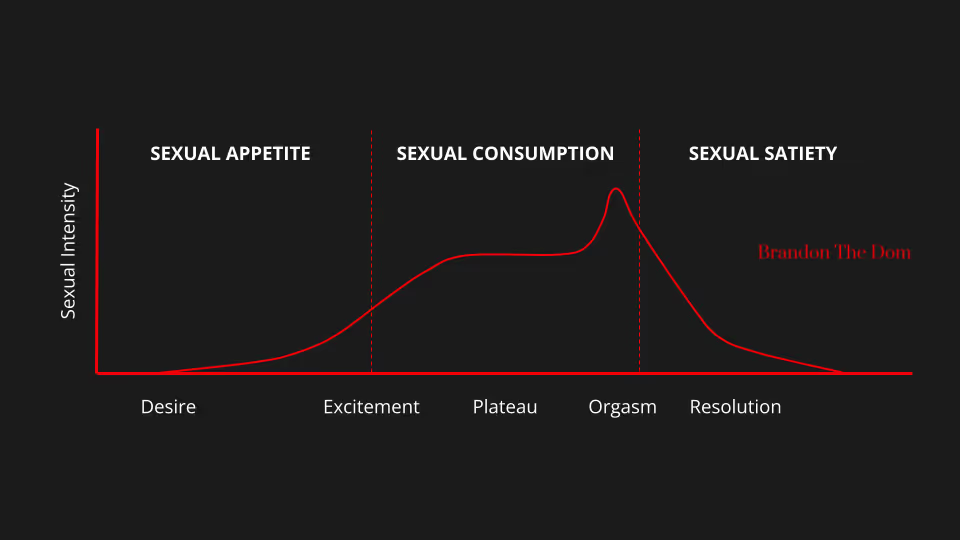
This cycle serves as a useful model for sequencing sexual interactions in a way that creates a satisfying experience for both people.
Consider which actions increase her desire and excitement, which actions help sustain arousal as she builds toward orgasm, which actions tip her over the edge, and which ones are designed to bring her gently back down to earth.
In BDSM, we call these structured progressions scenes, and there is an entire art to crafting them well.
For her, they help create familiarity with you, deepen her submissive headspace, and warm her body up for greater intensity.
For you, they help you learn her body and how she responds to your actions, allow you to build confidence as the scene progresses, and ensure you have a range of experiences to draw from throughout the session.
Step 5: Dynamic, Varied Intensity
Once you’ve started learning a few techniques and begun understanding how to sequence them, you can start focusing on varying your intensity throughout the session.
Think of it like a roller coaster—you’re moving up and down in intensity. Essentially, what you’re creating are pattern interruptions.
This creates a more engaging experience than staying exclusively in low-intensity, soft, sensual territory—where things may become under-stimulating—or remaining in constant high-intensity, rough, hard intensity, where things can become overstimulating or overwhelming.
Doing this well takes practice because you have to become attuned to your partner’s body language, recognizing when their body is open and inviting more, and when it begins to constrict and needs you to back off a little.
Signs the Intensity Feels Good
- Low moaning or growling
- Deep breathing
- The body tenses but quickly relaxes
- The body moves in a steady rhythm
- She presses her body toward you, inviting more touch
- She opens her legs, arms, or body toward you
- She pulls you in closer
Signs the Intensity May Be Too Much
- Gasping, sharp intakes of breath, or breath-holding
- Noises or moaning suddenly stop
- The body tenses and does not relax
- Sharp cries of pain
- Pulling the body away from you
- Closing the body off from you
- Pushing you away
One additional benefit of varying intensity is that it can help you regulate your own arousal, potentially allowing you to last longer.
Crucially, you generally do not want to change intensity when they are close to orgasm. At that point, they often need consistent stimulation—at whatever intensity level you’ve reached—to help carry them over the edge.
Step 6: Aftercare
Aftercare is a post-scene ritual that helps you transition from the headspace of the interaction back into everyday reality while mitigating—or sometimes avoiding—the emotional lows associated with experiences like subdrop.
For many people, aftercare may look like cuddling with a partner, wrapping up in a warm blanket, eating, drinking, or simply resting together. But it doesn’t have to look that way. For some people, what they need might be space, solitude, or even a cold shower.
Aftercare is whatever care you need after engaging in something intense.
Rather than dictating what aftercare should look like, I recommend discussing with your partner what it looks like for each of you.
What I do want to emphasize is that aftercare matters for both people.
Even if you were the one doing the actions, you may still need help transitioning out of the headspace created by what you just engaged in. I point this out because one of the mental gremlins you’re likely to encounter afterward is tied to the complexes we discussed earlier: questioning whether you’re a monster for having done some of those things to her.
Receiving reassurance during this period can be tremendously helpful in rewriting those narratives.
The more you hear that yes—they loved it, want it again, and do not think you’re a monster—the easier it becomes the next time.
Learn to Crawl Before You Choke Someone
Rough sex is one of the best places to begin building your technical skills as a Dom. It requires little more than your body, your attention, and a willingness to learn.
You don’t need to master every kink overnight.
Start small. Pick one skill. Get clumsy. Improve. Learn what creates arousal for the person in front of you.
Over time, as your competence and confidence grow, you can begin layering in new skills and kinks—bondage, impact play, power exchange, psychological play—creating richer, more varied experiences while still relying on the foundations you built through rough sex.
Because good Dominance isn’t about doing more.
It’s about becoming more skillful, more intentional, and more attuned to how you create the experience.
And that mastery is built one practiced skill at a time.

Master the 12 essential steps to become a good Dom—build the skills, mindset, and presence of a man she respects, desires, and willingly surrenders to—inside and outside the bedroom.
Learn MoreRelated Articles
.avif)
Men's Guide to Dominant Sex in the Bedroom
Continue Reading
A Complete Guide to Dirty Talk for Doms
Continue Reading
A Pleasure Dom is Not What You Think It Is
Continue Reading
