Containment: 14 Dominant Skills for Creating Safety, Security, and Surrender

How does containment create safety and surrender in BDSM? Discover 14 Dominant skills for building trust, regulating emotions, and embracing greater intensity.
Summary:
Containment in BDSM is the practice of creating the emotional, physical, and structural conditions that allow a submissive to feel safe enough to relinquish control and surrender to their Dominant. It involves three foundational domains: internal containment (the Dominant's ability to regulate themselves), interpersonal containment (their ability to remain attuned and responsive to their submissive), and structural containment (their ability to provide clear direction, boundaries, and consistency). Containment does not mean eliminating intensity or uncertainty. Instead, it creates the conditions for greater arousal, vulnerability, and surrender while maintaining safety and consent. Through 14 practical skills, Dominants can develop these capacities and build earned trust through repeated experiences of responsible leadership.

A long time ago, I learned that for a woman to become aroused and orgasm, she needs to feel safe. Ever since, I've been obsessed with understanding what actually creates that felt sense of safety.
In my own experience, the safer a woman feels, the more aroused she can become, the more freely she can enjoy her pleasure, and the more deeply she can surrender to me and the moment.
But here's the paradox: How can a woman feel safe while being roughly handled, overwhelmed, or pushed to the edges of her pleasure?
Because safety is about more than simply being physically safe (though that's essential). It's knowing that no matter what happens, how intense things become, or how she expresses herself, you've got her.
She doesn't have to constantly monitor her safety or decide what happens next. She can relinquish control because she trusts you to hold the experience.
This is what I call containment: creating the conditions in which someone can let go, experience enormous intensity, and trust that you'll remain present, attentive, and in control.
But how do you actually create that?
I have little patience for vague concepts that sound profound but offer nothing practical. So let's explore what containment is, what research suggests about why it works, and 14 skills you can develop to help your submissive feel safe enough to truly surrender.
Quick warning: Once you understand the 12 steps of Erotic Leadership, you won’t just “play Dom”—you’ll become the man she can’t stop thinking about. The man she trusts to take her deeper than she’s ever gone. The man she aches to surrender to. Get the training here.
What Is Containment?
In the erotic and relational realm, I define containment as the act of creating conditions that allow someone to become highly emotionally, sexually, or physiologically activated and let go of internal control while relying on the external control and certainty of another person who remains present, regulated, and responsible for the experience.
If we back up for a moment and consider what makes something feel unsafe, it's usually a combination of feeling out of control (of ourselves, the moment, or the environment) and experiencing uncertainty or unpredictability. We don't know what will happen, and we don't know how to handle it if it does.
Safety, on the other hand, comes from feeling in control and experiencing a degree of certainty and predictability. We know what might happen, and we trust that we can handle it if it does.
That's all well and good. Safety helps create regulation. However, regulation shouldn't be confused with low arousal or low autonomic activation, especially when it comes to sex or BDSM.
In fact, research from Cindy Meston's lab at UT Austin found a curvilinear relationship between sympathetic nervous system activation and women's sexual arousal. Too little activation can create boredom. Too much can create anxiety or overwhelm. Moderate sympathetic activation, however, can facilitate sexual arousal.
The goal of containment isn't simply to make someone calm, which is often what people first think: We need to help them relax.
Instead, the goal is to help them manage and regulate higher degrees of activation by distinguishing intensity from danger.
During sex or an intense BDSM scene, someone might be breathing heavily, their heart pounding, sexually excited, scared, physically struggling, or experiencing intense sensations while simultaneously having a deep interpersonal sense of "I'm safe with you."
The person being contained is allowed to feel out of control and experience a degree of unpredictability because the other person remains in control and is predictable enough to be relied upon for safety. The experience may be intense, but they trust that they are not in danger.
We can map these two dimensions—activation and uncertainty—to illustrate the different experiences they can create.
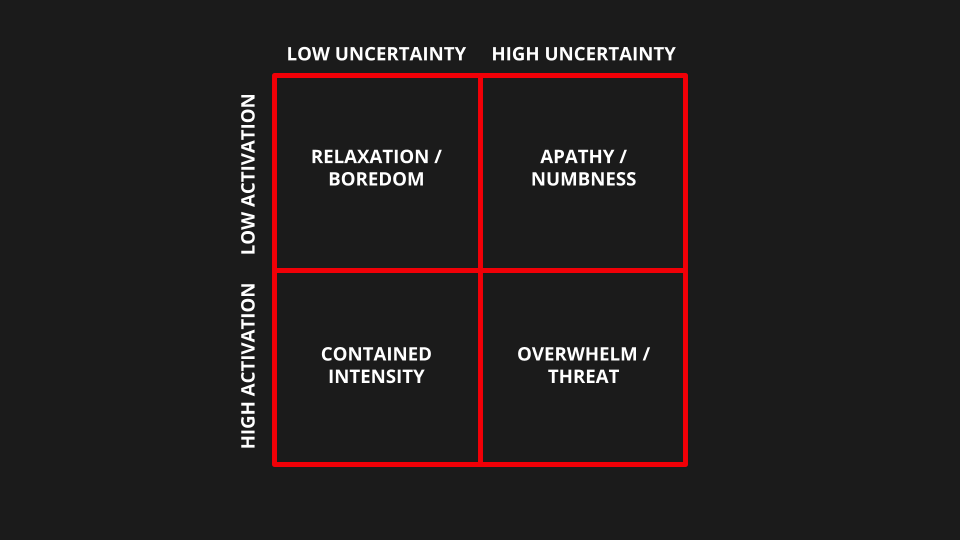
The goal of containment is to reduce uncertainty enough that moderate to high levels of activation don't become overwhelming or threatening.
In the realm of BDSM, the Dominant provides this stable, organizing container while the submissive becomes increasingly emotionally, sexually, or physiologically activated within it.
During a scene, the submissive's arousal might climb from a 3 to a 5, then a 7, and eventually an 8, while the Dominant remains controlled and responsive. The Dominant doesn't necessarily need to bring the submissive back down to a 3. Instead, they make it possible for an 8 to remain tolerable—or even pleasurable.
Why Is Containment Necessary for Surrender?
The simple answer is that if one person is giving up control, someone else needs to take responsibility for managing the uncertainty and unpredictability of the situation. But the actual mechanisms through which containment is created and surrender becomes possible are much more complex.
Let's reverse-engineer each element, starting with surrender and working backward to understand why containment is necessary.
To surrender means to stop resisting, yield to someone else's control, and engage more deeply in an experience. This is distinctly different from collapsing or shutting down, in which someone attempts to engage less in an experience by disconnecting or dissociating.
From the outside, both can look similar: someone might become quiet, compliant, limp, or less verbal. But surrender involves becoming absorbed in an experience, whereas collapse involves trying to escape from it.
In BDSM, this mental state of absorption is known as subspace, a euphoric, in-the-moment experience rather than one of dissociation or detachment. It's often associated with a complex interplay of hormones and neurotransmitters, including adrenaline, cortisol, endorphins, oxytocin, and dopamine.
A 2009 study titled Hormonal Changes and Couple Bonding in Consensual Sadomasochistic Activity showed that participants who were bound, receiving stimulation, or following orders experienced significant increases in cortisol during scenes. Those providing stimulation, orders, or structure did not show the same increase. Yet when participants judged the scene as having gone well, cortisol subsequently decreased, and relationship closeness increased.
An integrative research model on pain kinks also suggests that altered states of consciousness may help people experience pain as pleasurable.
What these findings suggest is that a submissive may be highly activated, with their stress or arousal increasing, while simultaneously experiencing pleasure and subsequently feeling greater closeness with their partner.
However, subspace may also temporarily reduce executive functioning and self-monitoring.
A 2016 study titled Consensual BDSM Facilitates Role-Specific Altered States of Consciousness measured cortisol and testosterone levels and had participants complete a Stroop test, commonly used to assess cognitive control.
When comparing pre- and post-scene results, researchers found that bottoms experienced decreased stress, increased sexual arousal, and a substantial decline in performance on the Stroop test.
This suggests that for subspace to be experienced safely, someone needs to assume greater responsibility for executive functioning, decision-making, and monitoring safety.
The same study found that topping was associated with a state resembling flow: a decrease in self-consciousness accompanied by complete absorption, intense focus, and energized involvement in the experience.
In other words, the roles are complementary. The Dom pays more attention so the submissive can pay less attention.
This helps illustrate the distinction between collapse and surrender:
- Collapse: "I'm losing control because something is happening to me that I can't manage."
- Surrender: "I'm relinquishing control because someone I trust is managing the structure."
The submissive may be able to tolerate substantially greater sexual, emotional, or physical intensity without interpreting that intensity as requiring escape or self-protection because some of the cognitive responsibility for monitoring and decision-making has been transferred to the Dom.
Unsurprisingly, qualitative BDSM literature repeatedly identifies trust as the foundation of submission.
One study specifically examining women's experiences of submission found that participants described trust and negotiation as prerequisites for engaging in power exchange. Similarly, research into long-term Total Power Exchange emphasizes trust as foundational to the authority relationship.
But I think that trust develops through a particular kind of learning experience: the submissive makes themselves vulnerable, experiences the Dom's competence in keeping them safe during intensity, and consequently feels safer in future experiences.
Each successful experience of the submissive exposing their vulnerability and the Dom handling it competently builds trust, not just intellectually, but within the submissive's nervous system.
When it comes to surrender, I believe it's the nervous system we're actually working with.
Social Baseline Theory may help explain why. The basic idea is that human nervous systems don't operate as though we're fundamentally isolated individuals. Familiar, reliable others can reduce the resources we need to devote to monitoring threats and regulating ourselves. Later reviews describe familiar and predictable others as making emotional regulation less energetically demanding.
One example comes from the Lending a Hand experiment, in which married women underwent fMRI scans while anticipating possible electric shocks. During the experiment, they either held their husband's hand, held a stranger's hand, or held no one's hand.
Holding their husband's hand reduced activity in neural systems associated with threat responses.
A literature review titled Physiological Linkage in Couples and Its Implications for Individual and Interpersonal Functioning examined evidence that romantic partners' physiological responses can become linked through measures such as heart rate, respiration, electrodermal activity, cortisol, and respiratory sinus arrhythmia.
The researchers distinguish co-regulation from mere physiological contagion. Co-regulation describes partners jointly moving toward greater stability, whereas physiological contagion can involve escalating one another's arousal.
For example, one partner may be calm and grounded while the other is anxious and vigilant. Through the first partner's actions and their interaction, the second partner's physiological state may begin to shift toward greater regulation.
One mechanism that a partner could do that has been studied extensively is touch.
A review of affective touch describes how affectionate touch plays a fundamental role in developing stress regulation, attachment, and close relationships.
Experiments have found that a brief embrace with a romantic partner before an acute stress task reduced women's cortisol responses, while receiving a hug reduced cortisol responses to stressors.
Another study found that spontaneous, nonverbal expressions of intimacy from a partner were associated with reduced cortisol reactivity in women and faster cortisol recovery in both women and men following stress.
However, the previously mentioned literature review also suggests that the reverse is possible: an anxious partner can influence the other person toward greater anxiety.
Simply having synchronized physiological responses isn't necessarily desirable. The research cautions that synchrony can represent either connection or mutual dysregulation, depending on the context.
What this suggests is that both the state of the person you're co-regulating with and the context in which that interaction occurs matter.
This is particularly relevant to BDSM.
An integrative research model examining how pain can become pleasurable identifies context as one of the contributing factors that shape how sensations are interpreted and may facilitate altered states of consciousness, such as subspace.
So what makes up that context?
A review titled Pursuing Safety in Social Connection: A Flexibly Fluid Perspective on Risk Regulation in Relationships describes how humans seek relationships in which they feel safe depending on another person.
The researchers identify signals such as partner responsiveness, affectionate touch, and relational power that influence whether people move toward connection or self-protection.
We continually monitor another person's behavior for reliable evidence that it's safe to reduce our vigilance and self-protection.
We've already discussed touch, but partner responsiveness and support for sexual autonomy, especially in relationships involving power differentials, are also important components of sexual satisfaction.
Partner responsiveness means experiencing another person as someone who understands you, cares about you, and responds appropriately to your needs.
Research defining sexual need responsiveness emphasizes listening to verbal and nonverbal cues and accommodating a partner's desires while preserving their boundaries and ability to make autonomous decisions without pressure, shame, or guilt.
Researchers have also found positive relationships between intimacy, partner responsiveness, and sexual desire. The literature they review suggests that partner responsiveness may be especially important for women's sexual desire.
Even among strangers, people who perceived another person as responsive subsequently reported greater sexual interest in that person.
A series of three studies involving 786 participants also found that perceived sexual autonomy support—the experience of having a partner who supports one's ability to make sexual choices freely—was associated with greater sexual need fulfillment and higher sexual and relationship satisfaction.
Another phenomenological study of BDSM eroticism found that the experience was co-created: partners collaboratively constructed and maintained the erotic fantasy and power exchange rather than one person independently imposing it.
In other words, the context must include having one's needs and boundaries heard, integrated, respected, and, most importantly, responded to by the other person.
But what about the person we choose to surrender to?
A qualitative study of long-term BDSM relationships found that power exchange served purposes beyond sexual gratification, including bonding and providing a sense of security.
Recurring themes included high levels of trust, communication, transparency, concern for the partner's happiness, and collaboratively constructing a relationship that worked for both people.
Attachment research also consistently connects attachment security with sexual functioning. A systematic review found that greater anxious and avoidant attachment were associated with lower sexual satisfaction, more sexual dysfunction, and differing motivations for engaging in sex.
Attachment theory also aligns with Social Baseline Theory.
A trusted partner becomes a secure base from which someone can explore, relinquishing some of their vigilance because they trust that person to remain attentive to their safety.
But for a Dom to monitor their submissive effectively, they must also be self-contained and possess a sense of security within themselves. Otherwise, their attention may become focused inward rather than on the person they're leading.
Remember our earlier model: The submissive can surrender because the Dominant assumes more of the monitoring burden.
The Dominant needs to remain aware of the submissive's body, arousal, emotional state, and boundaries, as well as the environment, pacing, their own body and intensity, and what will happen next.
If a Dominant doesn't feel secure within themselves, they're being asked to provide the very things that become difficult when their own nervous system starts asking, "Am I enough?" or "Am I too much?"
They need to remain present, decisive, attentive, sexually responsive, physically capable, and emotionally steady, often while receiving immediate feedback from another person's body about how well things are going.
This can turn Dominance from the act of containing an experience into the experience of receiving a report card.
That perceived evaluation can activate the Dominant's own threat response, inhibit sexual performance, and interfere with the flow state described earlier.
Contemporary clinical literature defines sexual performance anxiety as the fear that one won't respond adequately to the demands of sex with a partner. A recent theoretical model specifically emphasizes how anxiety can interfere with the very sexual responses a person is attempting to produce.
There's also research supporting the attentional component. Sexual researchers have long discussed spectatoring, the process of shifting from participating in a sexual experience to observing and evaluating one's own performance.
It's impossible to effectively contain another person's experience when you desperately need their experience to regulate your own.
Imagine the submissive is crying, shaking, screaming, struggling, withdrawing inward, or becoming overwhelmed—whatever might be appropriate for that particular person and scene.
If the Dominant begins interpreting those reactions as an evaluation of themselves (internal focus), rather than remaining curious about what's happening in the scene (external focus), they may start needing the submissive's experience to change to obtain the validation they're seeking.
They may unconsciously need the submissive to moan more, orgasm, praise them, go deeper into subspace, or otherwise communicate, "Yes, you're enough."
Suddenly, the submissive has been given a monitoring and regulatory responsibility while supposedly being invited to surrender.
They may begin reassuring the Dominant, faking reactions, withholding feedback, or managing the Dominant's confidence.
Now both partners are performing, and the container begins to collapse.
So, for surrender to become possible, I believe three components are necessary:
- A self-regulated Dominant who can remain mentally and emotionally available to assume greater cognitive responsibility for monitoring the submissive and managing the experience.
- An attuned and responsive interpersonal relationship that supports autonomy, respects boundaries, and communicates safety through mechanisms such as touch, responsiveness, and emotional connection.
- A clear structural context that reduces ambiguity, establishes predictability, and lessens the submissive's cognitive burden.
Together, these elements create a container in which someone can develop enough initial trust to become vulnerable through submission.
And through repeated positive experiences of being vulnerable, having their needs met, and experiencing the Dominant's competence, that initial trust can deepen into a felt sense of safety—one that allows the submissive to surrender more fully and let go.
How to Create Containment
Based on the components identified earlier, we can organize containment into three foundational domains that produce an outcome that reinforces the container over time:
- Internal Containment: I can hold myself.
- Interpersonal Containment: I can hold space for you.
- Structural Containment: I can hold the experience.
- Outcome: Earned trust through repeated experiences of surrendering and feeling held (contained). That trust reduces the resistance to surrender and makes containment easier over time.
I'm going to break down each of these foundational domains into practical skills that can be developed and improved.
While strengthening any one of these domains can help create a greater felt sense of safety, many of the skills build upon one another. I believe the best place to start is with internal containment.
She won't just submit in the bedroom: Imagine her eagerly following your lead, anticipating your desires, and finding pleasure in serving you throughout the day. Designing Dynamics teaches you and your partner how to turn occasional kinky encounters into a deeply fulfilling power exchange relationship built on trust, devotion, and mutual desire. Start building your dream dynamic here.
Internal Containment
Before you can hold space for someone else's experience, you need enough capacity to remain present within your own.
A Dominant is, first and foremost, a person. And a normal part of being human is experiencing anxiety, excitement, uncertainty, insecurity, frustration, intense arousal, fear of inadequacy, or the desire to impress.
Too often, people mistakenly believe that a Dom shouldn't experience these emotions, that they should always remain unmoved. But that would also mean shutting down the emotions and experiences influenced by their partner, including love, joy, and desire.
Instead, internal containment means allowing these experiences to exist without letting them automatically determine your behavior. You can feel them fully while remaining present in the moment, without needing it to be any different from what it is.
The goal isn't for nothing to affect you.
It's to be affected without becoming controlled by what you're feeling.
Skill 1: Inner Awareness
Awareness, in simple terms, is the ability to observe what's happening inside you and around you without judgment.
I'm not talking about being self-aware in the sense of examining your beliefs or the stories you tell yourself—though that can be very beneficial, especially when examining your beliefs about relating to others.
Instead, I'm referring to awareness of your internal state, particularly your thoughts, emotions, and bodily sensations. You need to recognize activation before you can regulate it.
Learn to recognize your early warning signs:
- Holding your breath
- Tension in your jaw or shoulders
- Rushing
- Tunnel vision
- Losing awareness of your partner
- Becoming unusually quiet or talkative
- Trying harder
- Needing a particular reaction
- Monitoring your erection or sexual performance
- Feeling irritated when something doesn't go as planned
All of these can influence how you interact with others. The more aware you become of these signals, the better equipped you'll be to respond to them in ways that support your desired outcome.
Thoughts
We're starting with thoughts because they're likely what you identify with most.
A thought appears in your mind, and you seemingly accept it as true. It feels like you—who you are, what you believe, and what you're telling yourself.
Yet we have countless thoughts every day. Some contradict one another, some are irrelevant, some are positive, some are negative, some are useful, and others aren't.
The more objectively you observe your thoughts—without investing excessive emotional energy in them or tying them to your identity—the more you'll notice how many stem from conditioning and programming you've absorbed from others, including parents, family, friends, media, and society.
Your thoughts are no more a representation of who you are than a slogan on a billboard in the middle of Wyoming.
The problem is that you can become so enamored with your thoughts that you grasp onto them as though they're gold.
This prevents you from fully experiencing reality, where the actual information about what's happening resides.
As a result, you may misunderstand people, misconstrue situations, misinterpret others' emotions, speech, and body language, and ultimately create a great deal of misery for yourself because the world doesn't match the version you've constructed in your head.
The world doesn't exist in your head. Your partner doesn't exist in your head.
If you want to show up as a powerful person, not just a powerful Dom, you'll need to get out of your head. You need to stop clinging to every thought that crosses your monkey mind and learn to discern which thoughts are useful in the moment and which are simply noise.
One exercise that helps develop this skill is meditation, which teaches you to focus on the present moment without grasping onto your thoughts.
Many people have tried meditating and felt they were failing because they couldn't quiet their minds.
But the goal of meditation isn't necessarily to quiet the mind (though that may eventually happen to some degree). Rather, it's to recognize that your thoughts are just one part of your awareness and that you don't need to cling to them.
In fact, if you have a particularly active mind full of thoughts, consider yourself lucky! You get more opportunities to practice noticing a thought and letting it pass.
Simple Breath-Focused Meditation
- Find a comfortable position. You can practice meditation anywhere and in almost any position. However, if you're making this a daily practice, choose a comfortable spot where you can sit with your feet flat on the floor or your legs crossed.
- Set your intention. Briefly bring to mind why you're doing this practice. Why do you want to cultivate greater awareness? Notice that desire, then let it go. There's no need to hold onto it or continue thinking about it. You've set your intention, so allow it to pass.
- Set a timer for 10 minutes. I recommend choosing a gentle alarm sound rather than something resembling a fire truck siren.
- Close your eyes.
- Focus on your breath. You can do this by noticing your belly expanding as you inhale or by concentrating on the bridge of your nose, feeling the air move in and out of your nasal passages.
- Notice your thoughts without engaging them. As you practice, thoughts may flood into your mind like football fans filling a stadium. You don't need to ignore or suppress them. Simply notice them and let them pass.
- Use counting if necessary. Sometimes, letting thoughts pass is easier said than done. If you're struggling, strengthen your focus on your breath by counting. On the inhale, count 1; on the exhale, count 2; inhale, count 3; exhale, count 4; and so on until you reach 10. Then start again at 1. If you lose count, simply return to 1. This helps redirect your attention away from your thoughts and back to your breath.
Over time, your mind may become less distracted by thoughts, and you may no longer need to count. You'll become better at noticing a thought and letting it go without becoming caught up in it.
You're welcome to meditate for longer, but even 10 minutes a day can help cultivate the awareness necessary to become more present with others.
Body
Next up is the body.
If you're caught up in your head, you're likely losing awareness of how your body is actually interacting with the world around you.
Your body is like a giant sensor, constantly collecting information. If you don't pay attention to it, you'll miss a great deal of valuable feedback.
Being present in your body is also immensely pleasurable, especially during sex. After all, the present moment is the only place where you can actually experience all the sensations that make sex so enjoyable.
No doubt there's been a time when you've experienced sexual performance anxiety, whether that meant losing an erection, having difficulty orgasming, or experiencing diminished arousal because you were anxious about the situation.
This can happen when you become stuck in your head, focusing so much on your thoughts that you lose awareness of the pleasurable sensations happening in real time.
So let's start reconnecting with the somatic experience of your body.
Essentially, I want you to get out of your head, stop dwelling on the made-up stories about your experience, and reconnect with what you're actually feeling in your body.
You can develop this ability by improving your interoception, or your awareness of your body's internal signals and states.
Your practice is to check in with yourself several times throughout the day, identifying bodily sensations and connecting them to your emotional state. Set reminders if necessary to help you remember.
You can also strengthen your ability to remain connected to your internal state through body scans.
Body Scan Practice
- Get comfortable. Find a position where you can relax without being distracted.
- Bring your attention to your body. Take a few slow, deep breaths, then mindfully direct your attention to your feet. Notice any sensations you experience without judgment or evaluation.
- Move through your body. Gradually shift your attention to your lower legs, continuing upward through each body part until you reach your head.
- Describe what you feel. Use specific, descriptive words such as squishy, tense, hot, buzzy, relaxed, sharp, or heavy, rather than evaluative words such as good, bad, or hurt.
The goal isn't to judge a sensation as negative because it's painful or positive because it's pleasurable.
Instead, we're simply developing awareness of what's occurring.
Emotions
Next, we move to emotions because there's a good chance you're either too caught up in them—blowing up at people over the smallest things—or largely oblivious to them, shutting them out behind an iron gate.
Turning off your emotions doesn't mean you have control over them. It simply flattens your emotional experience and allows you to avoid dealing with what you're feeling.
Instead, you want to allow emotions to flow through you, feel them fully, and resist the urge to grasp onto them or react impulsively.
When someone sees that you trust yourself enough to experience your own emotions, they may feel safer being vulnerable and sharing theirs with you.
They can begin to trust that you're capable of handling not only their deepest expressions of joy, bliss, and pleasure but also their anger, sadness, and despair.
If you want to experience positive emotions fully, you need to be willing to experience the negative ones, too. You don't get to pick and choose.
Eventually, you may come to recognize that all emotions serve a purpose and begin to let go of labeling them as positive or negative altogether.
First, you need to learn how to remain present with your emotions, particularly the sensations they create in your body, without becoming attached to the stories you assign to them.
This requires cultivating awareness (recognizing what's happening) and presence (remaining engaged in the moment), both of which must be practiced repeatedly.
Every emotion deserves to be felt, especially the ones you'd rather avoid.
As you practice, you'll begin to recognize that these emotions don't change who you are at your core. The pain doesn't destroy you. You're okay, even when everything around you feels chaotic.
Learning to remain present with intense emotions—especially those triggered by another person or situation—can help you recognize them as sensations and energy moving through your body, rather than something you must immediately act upon or explain.
This can be difficult because when you're caught up in a story about an emotion, such as blaming someone else for how you feel, that story can prevent you from fully experiencing the emotion itself.
Intense Emotions Practice
- Separate the emotion from the story. To the best of your ability, distinguish the thoughts and narratives you're assigning to the experience from the emotional sensations themselves.
- Invite the emotion closer. Rather than pushing it away, bring your attention to the sensations it creates in your body.
- Feel the raw emotion. Notice the energy of the emotion itself, whether it's joy, excitement, anger, fear, desire, or frustration.
- Allow it to move. Let the emotion pulse and surge through your body without grasping onto it or pushing it away.
- Avoid identifying with or denying the emotion. Find the balance between acknowledging what you're feeling and becoming consumed by it. Allow the experience to move through you without needing to control it.
- Notice when you become stuck. If you find yourself grasping onto the emotion or feeling as though it's stuck somewhere in your body, examine whether there's a story or belief you're holding onto that you can set aside.
- Return to the present. When you feel the emotion has run its course, ground yourself in the present moment by performing a body scan, as we practiced earlier.
With practice, you may be able to work through this exercise in just five minutes whenever you find yourself triggered or overwhelmed by emotions.
Setting aside dedicated time for this practice can also help ensure you're not bottling up emotions or habitually avoiding them.
I recommend combining these exercises into a daily practice: meditation, body scans, and emotional digestion.
Skill 2: Self-Regulation
Now that you're aware of what's happening inside you, the next step is learning to choose how to respond. In other words, learning to self-regulate.
Self-regulation is the ability to monitor and recognize changes in your attention, thoughts, emotions, and behaviors so you can respond thoughtfully to stressors and take actions toward desired outcomes rather than reacting impulsively.
What's important in this context is that regulation doesn't mean relaxation. During a BDSM scene, you may be highly activated, aroused, or anxious. Regulation means maintaining enough executive capacity to consciously choose your next action.
The practice involves learning to remain present with mild activation without immediately trying to change it.
Ask yourself:
- What am I feeling?
- Where am I feeling it in my body?
- What do I immediately want to do?
- Do I actually need to act on that urge?
For example, you might notice that you're feeling anxious or uncomfortable. Normally, your impulse might be to immediately fix whatever is causing that discomfort.
Instead, use that impulse as a signal to pause, get curious, and consciously choose your response.
Focusing on your breath, noticing the weight of your feet on the floor, slowing your movements, orienting yourself to the room, making physical contact, or simply naming your experience can all help.
The deeper practice is remaining capable of making conscious choices even while your body is highly activated.
You may discover that your anxiety has been triggered by an insecurity, that you're excited but uncertain, that you're acting outside your own values or boundaries, or any number of other things.
Sometimes, these discoveries will call for action. But the appropriate action is often different from your initial impulse, such as being vulnerable about your insecurity rather than becoming defensive.
Other times, no action is needed at all. Simply remaining present and engaged with the experience may be the best choice, such as when you're experiencing intense pleasure and feeling slightly overwhelmed by it.
The point is that you're in the driver's seat. You made a conscious choice.
Your partner wants to be led by your conscious decisions, not your unconscious reactions.
Skill 3: Distress Tolerance
Some of the most uncomfortable feelings you'll experience in life are associated with uncertainty. Yet much of life is uncertain, and we're frequently required to act or make decisions without knowing how things will turn out.
As a Dominant, you're being asked to make decisions for two people. With that added responsibility, uncertainty can sometimes feel debilitating.
One of the paradoxes of leadership is that followers are drawn to those who appear certain, yet leaders must continually make decisions about uncertain outcomes.
How you respond to that uncertainty can either cultivate your submissive's confidence in your leadership or undermine their trust in your decisions.
Even within a scene, can you tolerate the discomfort of not knowing:
- Whether it will work?
- Whether they'll orgasm?
- Whether they'll reach subspace?
- Whether they'll enjoy trying something new?
- Whether you're reading their responses correctly?
- Whether they'll want to play with you again?
Can you continue to act without urgently needing to resolve that uncertainty?
Our instinctive response is often to try to make uncertainty disappear. This can lead to excessive checking, reassurance-seeking, escalating intensity, performing, or simply trying harder.
Instead, the practice is learning to sit with uncertainty without needing to immediately resolve it. You remain present with reality as it unfolds, gathering information and making better decisions based on what's actually happening.
You can develop this skill by deliberately exposing yourself to small amounts of uncertainty in everyday life.
For example:
- Don't immediately send another text when someone hasn't responded.
- Don't immediately explain yourself after a mildly awkward interaction.
- Don't immediately ask, "Was that okay?" simply because you feel uncertain.
- Don't immediately try to fix something without first getting curious about why it happened.
As with the previous skill, when the impulse arises, slow down, pause, and investigate before acting.
Over time, your internal compass can shift from needing certainty that everything will go well to trusting that you'll be able to handle and respond to whatever happens.
That's a much more durable form of Dominant confidence.
Skill 4: Embodied Presence
The work of the previous three skills is to free yourself from spending so much time in your head and bring your attention back to the present moment so you can actually engage with it.
You've turned down the volume of your mental chatter, increased your sensitivity to bodily sensations and emotions, and strengthened your ability to choose rather than react.
You're now better prepared to engage with the external world because you've developed greater confidence in your ability to handle whatever it brings.
That confidence is often communicated through your body.
You might call it presence, groundedness, attentiveness, or calmness. Whatever term you use, there's a felt sense that you're fully engaged with the moment without being overwhelmed by it.
This kind of embodied presence can help initiate the co-regulation process, making someone else feel safer being vulnerable with you because they trust that whatever they express, you'll remain present and engaged.
This isn't something you can simply fake. It requires the work of the previous skills.
As your anxiety and reactive tendencies lessen, your body will naturally become more at ease. When you're less afraid of the world or your reactions to it, you'll become more comfortable engaging with it.
That said, you can help cultivate this process by deliberately practicing ways of being present that may have made you uncomfortable in the past.
For example:
- Breathing more deeply and naturally
- Slowing your movements without feeling the need to rush
- Introducing pauses or extended silences without needing to fill them
- Speaking clearly without artificially changing your voice or "acting dominant"
- Relaxing your posture and releasing unnecessary muscular tension
- Paying attention to the person you're interacting with rather than constantly looking inward
- Making and maintaining eye contact with others
- Slowing your touch and using a firm, intentional grasp rather than rushing or touching timidly
The goal isn't to appear confident. It's to feel settled and comfortable in the moment so that the behaviors you choose to express emerge naturally.
Skill 5: Deliberate Intensity
Here's where all the work of self-containment pays off.
BDSM can be intense. And for those of us drawn to it, that intensity is exactly what we're craving.
We want the intense emotions, the rough sex, the overstimulating sensations, and the roller coaster of highs and lows that come with our scenes.
But we don't want to be unsafe.
The submissive wants to feel the "monster" inside the Dominant. They want you to fuck them like an animal, destroy them, and completely fucking own them with your entire being.
But they don't want the Dominant to be out of control. They need them to be in control.
If a boundary is approached or a safeword is called, you need to be able to respond immediately.
Intensity is not dysregulation.
As with the previous skills, the submissive wants the Dominant to actively choose and be deliberate about their intensity.
A Dominant doesn't need to be gentle to be grounded. You can move someone forcefully, speak sternly, create fear, give demanding commands, or generate enormous sexual arousal while remaining internally organized.
The practice is learning to deliberately increase intensity while remaining capable of maintaining control and immediately reducing or stopping that intensity when necessary.
During this process, you'll notice your own arousal and activation.
Can you remain present and responsive to your partner and the moment without becoming swept away by your own intensity?
You'll also notice and experience your partner's arousal and activation.
As long as the experience remains safe and consensual, can you maintain that intensity without becoming afraid of it or feeling compelled to change it?
And most importantly, can you recognize when something is becoming unsafe, reduce the intensity, and stabilize the situation?
This is something you can practice even with emotions.
Anger, for example, is often demonized because people express it without control and cause harm. However, some situations may call for anger, such as when standing up for your values or defending an important boundary.
When consciously regulated, anger can be expressed deliberately and powerfully without becoming destructive.
The same principle applies to Dominance: You can express enormous intensity without surrendering control of yourself.
Interpersonal Containment
Once you can remain present with your own experience, can you remain present with theirs?
Creating containment for another person means allowing them to have and fully express their experience while remaining attuned and responding when necessary.
The submissive is intentionally letting go of control, and they need to know that you can handle it when they do. They need to trust that you're paying attention to them so they don't have to constantly monitor their own safety.
This is why we focused so heavily on internal containment first. You need to be grounded enough that you're not entirely consumed by your own internal state, leaving you unable to be present with theirs. You also need enough internal security that their experience doesn't become a referendum on you.
There's a difference between monitoring your partner to determine what will best serve the experience and looking for evidence to validate your own performance.
A submissive may become sexually excited, scared, vulnerable, emotional, overwhelmed, frustrated, tearful, highly stimulated, or deeply surrendered.
If every reaction becomes evidence about you—"They had an orgasm, I'm the best!" or "They didn't have an orgasm, I'm inadequate"—then you can't fully attend to your submissive. You're still caught up in your own internal experience.
Interpersonal containment requires enough internal security to let their experience be about them.
Only then can you respond in the way that best serves the moment.
Skill 6: Attunement
Having a stable Dom is great, but if they're oblivious to their partner's cues, they won't be able to make decisions that serve the moment.
Attunement is the capacity to perceive, respect, and understand another person's emotional, verbal, and nonverbal cues, allowing them to genuinely "feel felt" and safe.
When you're not preoccupied with yourself, you can direct your attention outward, focusing on your partner's cues and the scene as it unfolds.
You're continually gathering information from:
- Breathing
- Muscle tension
- Posture
- Movement
- Eye contact
- Voice
- Words and speech
- Responsiveness
- Sexual arousal
- Enthusiasm
- Withdrawal
What's particularly important is recognizing changes from your partner's usual baseline.
For example, someone becoming quiet could indicate contentment and satisfaction, fear, dissociation, boredom ,sinking deeper into subspace, or something else.
Each person's cues have meanings that are particular to them. While there may be some overlap in how people respond to different experiences, you can't learn containment simply by memorizing a list that says, "If they do X, it means Y."
Instead, you have to learn that person.
The best place to start is outside the bedroom.
First, simply observe your partner. Don't immediately judge or interpret their behavior. When something happens that affects them, get curious:
- What changed? Perhaps their speech became shorter, they started making more or less eye contact, their shoulders relaxed, or their jaw tightened.
- What might it mean? Form a hypothesis. Don't assume it's right or wrong. Simply make your best guess based on what you observed.
- How can I verify that? Most of the time, this means asking them about their experience. Something as simple as, "I noticed you clenched your jaw. Are you feeling frustrated about something?"
Whether your interpretation was right or wrong isn't actually the most important part.
If you were right, you've confirmed that you're accurately reading their signals. If you were wrong, your partner has an opportunity to share their experience, allowing you to understand them better.
Either way, your partner can feel that you're paying attention, that you care, and that their experience matters to you.
You can then bring this practice into your scenes.
For example, perhaps your partner becomes unusually still for a moment. After the scene, you might ask, "There was a point when you went very still. I interpreted that as you going deeper into the experience. What was actually happening for you?"
This helps you build an increasingly accurate map of your partner's unique signals.
Over time, you'll become better at recognizing what they're experiencing, sometimes before either of you needs an explicit explanation.
Skill 7: Responsiveness
Now that you're learning to accurately read your partner, you need to respond to their cues.
This is why submissives don't want Dominants who are completely unmoved or unaffected by their experiences. They need you to respond, make decisions, and act in the moment.
But remember, we developed those internal containment skills to ensure that your responses are conscious decisions rather than unconscious reactions.
Attunement makes your partner feel seen. Responsiveness shows them that you care and that their experience matters.
For example, imagine you're pleasuring your submissive, and they ask you to adjust your technique slightly to make it feel better. Listening to their request and changing what you're doing demonstrates that their pleasure actually matters to you.
Or perhaps you're spanking your submissive, and they flinch and tense their muscles. Responding by reducing the intensity or checking in demonstrates that their pain tolerance, limits, and safety actually matter to you.
The practice builds directly on attunement, but now we're adding a deliberate response:
- What changed? Observe your partner's verbal and nonverbal cues.
- What might it mean? Consider what those cues suggest about their experience, needs, or boundaries.
- How should I respond? Choose an action that best serves your partner and the moment.
Sometimes, responsiveness means slowing down, offering comfort, or stopping altogether. Other times, it means adjusting your technique, increasing intensity, or doing more.
And sometimes, it means not immediately rescuing someone from an intense experience they've explicitly said they want, provided they're still safe, consenting, and capable of communicating their needs.
This is why you can't be afraid of your partner's intense emotions, expressions, or reactions. You need to remain present enough to distinguish between intensity they want to experience and distress that requires intervention.
Your Dominance becomes a moment-to-moment practice of asking yourself:
"What does this person need from me right now?"
To improve your attunement and responsiveness, I recommend using aftercare or a later check-in to revisit significant moments from your scenes.
Ask your partner whether your interpretation of their experience was accurate, how they perceived your response, and whether that response actually gave them what they needed.
Over time, this feedback helps you become more accurate in reading your partner and more effective in responding to them.
Skill 8: Physical Manhandling
One of the most powerful ways to communicate "I've got you" is through touch.
Imagine for a moment that your submissive is stressed. They've had a shitty day at work. People have been making demands of them all day, and they've been carrying the weight of the world on their shoulders.
Then you come up behind them. You press your body against theirs. You wrap your arms around them, firmly positioning and holding them still. You steady your breathing, inviting theirs to slow as you draw their body securely against yours.
Without saying a word, your partner receives the message: "You're here. I'm here. I've got you. You don't need to manage anything right now."
Coming up behind someone and securely holding them, enclosing them within your body, can create a very literal form of containment: their body encounters your body as a boundary around theirs.
Touch itself can have regulatory effects in close relationships, and affectionate interpersonal touch has been associated with reduced stress responses and greater relational well-being.
But physical containment doesn't have to remain calm to provide that felt sense of being held. Remember, in BDSM, we often want intensity.
Now imagine the same embrace from behind, but this time, we dial up the intensity.
Your hand caresses the back of their neck, moving into their hair and massaging their scalp before giving a firm tug to expose their neck. Gentle kisses along their neckline turn into nibbles, eventually reaching their trapezius muscles, where you deliver a stronger bite. Your other arm wraps around the front of their body, squeezing and groping their chest as your hand moves upward to grasp their neck.
With each action, the submissive remains securely held, even as the intensity of the moment and their level of activation increase.
The skill of manhandling isn't simply about throwing your submissive around the bedroom. It's about physically leading them so they don't even need to contemplate what to do with their body, while communicating that you have control of the situation, of them, and, most importantly, of yourself.
You're not merely signaling that you possess the power to overpower or destroy them. You're demonstrating that the power you're applying remains fully within your awareness and control.
You've already done the work of developing deliberate intensity.
It's similar to a martial artist who understands exactly what their body is capable of and can deliver a strike with an intensity appropriate to the situation.
This is how being pinned against a wall, picked up and thrown onto a bed, or fucked roughly can also feel like being held throughout an entire experience.
So practice communicating "I've got you" not just through words, but through physical touch at varying degrees of intensity, calibrated to what the moment calls for.
At the height of a BDSM scene, those physical signals may be harsh and rough. During aftercare, they may be soft and featherlight.
But they're always responsive to what your submissive needs.
Skill 9: Protecting Their Autonomy
The paradox of power exchange is that a submissive exercises their autonomy to choose to relinquish control, essentially giving up some of that autonomy.
However, they do so only after establishing the boundaries within which they're willing to relinquish control and developing trust that you'll take responsibility for protecting those boundaries.
They're essentially saying, "Within these boundaries, I want you making these decisions."
Establishing those boundaries enhances their sense of safety. They know they don't need to remain constantly vigilant about being pushed into situations they genuinely don't want because you're protecting those boundaries.
This means that before any power exchange or scene takes place, you need to negotiate and become skilled at discussing things like:
- Needs
- Desires
- Boundaries
- Limits
- Uncertainties
- Risks
- What specific cues, such as safewords, mean
- What distress looks like for them
Then treat the information your submissive shares as important and useful, rather than interpreting it as topping from the bottom, insubordination, or criticism.
For containment, the skill isn't simply negotiation, though that's important. It's how you respond to those boundaries that actually creates safety.
In other words, become world-class at hearing and accepting a no.
If you respond to a no with aggression, defensiveness, pressure, manipulation, guilt, or anything short of acceptance, you'll make your submissive feel unsafe.
They'll learn that they can't rely on you to protect their boundaries—and ultimately their autonomy—when they're most vulnerable.
This applies to any expression of refusal in the moment, including saying stop, using a safeword, or expressing discomfort or dislike.
Again, this is why internal containment is so important. Their no doesn't have to be a reflection of your worth.
Hearing a safeword isn't a failure. Your submissive disliking something doesn't mean you're a bad Dom. Their choice is about them and their experience, not an evaluation of you.
When you respond positively to their boundaries, you create safety. When you demonstrate that their choices matter, you create safety.
The castle walls don't need guards because you are the guard.
One of my favorite exercises with new submissives, particularly those who are afraid to use their safewords or tend to be people-pleasers, is something I call the No Game.
Essentially, the goal is to teach your submissive that it's okay to speak up, assert themselves, say no, or use a safeword whenever they need to.
One version involves asking whether you can do something to them and having them practice saying no. Then you respect their answer and don't do it.
Another version involves beginning a mutually agreed-upon activity and having them practice saying "stop" or using their safeword. When they do, you immediately stop, check in, reassure them that they're safe, and tell them you're proud of them for speaking up.
That might seem silly, but consider how many times your submissive may have experienced someone disregarding their "no" or "stop."
Unfortunately, it's incredibly common.
I'll never forget one experience when a woman asked me to slow down for a moment. When I did, she was surprised. She told me it was the hottest thing she'd ever seen.
It nearly broke my heart to hear that.
Another, perhaps even more significant, practice is to honor anyone's no. Full stop.
Your friend doesn't want to go to the movies with you? Don't guilt them into going.
A client doesn't want to buy your service? Respect their decision. Consider offering an alternative that better addresses their needs or point them toward something that will.
Learn to live by the principle that you don't actually want anyone doing something they genuinely don't want to do.
I consider this a spiritual practice of consent.
Skill 10: Vulnerability
If you're the one taking responsibility, you probably place enormous expectations on yourself not to make mistakes.
You might believe you need to be the infallible Dom who's always cool, calm, and collected. You need to execute your skills perfectly, keep your submissive completely safe, and create an amazing experience—all while appearing effortlessly confident.
But behind that shiny mask often lurks the shadow of imposter syndrome.
The truth is, you're human.
Humans make mistakes. Humans have varying levels of skill. Humans experience emotions and insecurities.
You're not perfect.
Believing you need to be perfect can actually create its own safety risks because you may become more concerned with how you're perceived than with the experience unfolding in front of you.
You also can't build genuine confidence in something you're faking.
You can only develop confidence grounded in reality: your actual skill level, your current emotional state, and the situation unfolding in front of you.
A contained Dominant doesn't need to pretend to be invulnerable.
In fact, your submissive may want you to be vulnerable. They want to know they have an effect on you, that their expressions and experiences can penetrate that shiny mask you're wearing.
Being truthful about your experience and naming it out loud is far more grounded than pretending everything is fine.
Whatever you're experiencing—shame, insecurity, fear, uncertainty, or a lack of skill—is part of the reality of the situation.
Your submissive can't fully trust you if you're unwilling to acknowledge what's real.
However, there's an important difference between being vulnerable and seeking validation:
- Vulnerability: "I'm letting you know where I actually am without needing you to fix it."
- Validation-seeking: "I'm revealing this so you'll make my uncomfortable feelings disappear."
The practice is telling the truth while retaining responsibility for your experience, rather than making someone else responsible for changing it.
Reassurance may feel good in the moment, but ultimately, you're responsible for doing the inner work necessary to address those feelings.
This can be scary. We often don't know whether we can trust another person with our vulnerability.
But the paradox of trust is that it's often built on the other side of vulnerability.
When we disclose something vulnerable and the other person responds with care rather than using it against us, we begin to trust them more deeply.
In my experience, being the first to show vulnerability gives the other person permission to be vulnerable in return.
You create a shared culture in which it's okay to be imperfect, to express difficult emotions, and to be fully human with one another.
You become someone they can safely be imperfect around.
As with everything else, lead by example. Be the one who goes first.
Skill 11: Repair
Let me give you a news flash: You're going to fuck up.
I do. We all do.
No Dominant will always make the perfect move or read every situation correctly.
Occasionally, you'll make mistakes like:
- Misjudging intensity
- Giving a bad command
- Making a poor decision
- Forgetting something important
- Becoming overwhelmed
- Misinterpreting a response
- Planning a scene that doesn't work
- Going past a limit
How you respond to those mistakes will either undermine or repair the containment you've worked so diligently to create.
Containment begins to collapse when the submissive learns that if something goes wrong, you won't take responsibility for the harm you've caused, and they'll have to protect your ego instead.
Rather than becoming defensive, humble yourself and take responsibility for making things right.
Here's how I like to approach a mistake:
- Here's what I did: State the observable facts of the situation or mistake without defensiveness or justification.
- Here's why I did it: Explain the beliefs, values, or needs you were acting from. This helps the other person understand your intentions and learn more about you without excusing the behavior.
- Here's how my actions caused you harm: Acknowledge the impact of your behavior. The more precise you can be, the better, especially when identifying unmet needs or boundaries you've crossed.
- Am I understanding this correctly? Ask whether your understanding of their experience is accurate. Sometimes it won't be. This gives the other person space to clarify or expand on what they've shared.
- Given your experience, it makes sense that you feel the way you do: Validate their emotions and demonstrate that you understand why they're upset, not merely that they're upset.
- I'm sorry I harmed you in this way: Offer a genuine apology that acknowledges the specific harm you've caused.
For smaller mistakes, an apology may be all that's needed.
For more significant mistakes, however, you may need to take additional steps to repair the relationship:
- Ask what would help them heal or feel a sense of justice. You can offer suggestions, but ultimately, they're the one who determines what meaningful repair looks like for them.
- Determine how the mistake can be avoided in the future. This almost always requires action from both people. Remember, you’re on the same team and—ideally—want the same outcome.
- Commit to trust-building actions. Once you've agreed on a plan, follow through. Repair isn't just about intentions; it's about demonstrating consistent, trustworthy behavior over time.
Don't expect repair to happen quickly.
Trust can be broken in an instant, but trust and safety are built slowly, one brick at a time.
The potential benefit of successful repair is that the container may become even stronger afterward. Your submissive learns that when something goes wrong—and inevitably, something will—you won't abandon your responsibility, become defensive, or make them manage your emotions.
You'll remain present, acknowledge what happened, and take responsibility for making things right.
Your leadership never left.
Structural Containment
In a scene or a dynamic, you're responsible for yourself, your submissive, and the experience.
You're making the decisions. You're creating the structure. You're crafting the scene.
Imagine stepping outside your front door into an unfamiliar world. What would make that world feel less frightening?
Probably things like having a map, understanding the rules of that world and how it operates, and knowing which direction to go to reach your destination.
Structure serves as the map, rules, and direction within the fantasy world of a Dom/sub dynamic.
By establishing the boundaries within which the power exchange takes place, you reduce ambiguity and uncertainty. Your submissive knows that someone else is taking responsibility for the experience and that the environment has become more predictable.
This increases their felt sense of safety while simultaneously reducing their cognitive burden—both of which help create the conditions necessary for them to let go.
Skill 12: Decisiveness
Making decisions is a fundamental part of leadership.
In a Dom/sub dynamic, you'll be making decisions within the areas of authority you've agreed to take responsibility for. Even within a single scene, you're continually deciding what to do next.
Effective decision-making requires gathering and considering the available information, including your submissive's needs, desires, boundaries, limits, mental, emotional, and physical state, potential risks, the environment, and more.
That's a significant cognitive demand.
What's more, when you're the one making decisions, you're also taking responsibility for their outcomes. If something goes wrong, you're responsible for addressing it.
That's a lot of pressure.
This demand and responsibility are why many people shy away from being decisive.
But the benefit of making decisions is that you get to steer the situation in the direction you want it to go. Ideally, you're steering it toward an outcome that serves everyone involved.
For the submissive, your decisiveness removes a significant source of anxiety: ambiguity.
Instead of wondering what to do next, they know exactly what's expected of them. That certainty can be intoxicating.
Luckily, effective decision-making is a skill you can develop and refine.
My advice is to start small. In fact, start outside your Dom/sub dynamic:
- Your friend group can't decide where to go for dinner? Suggest a restaurant you'd like to try.
- Your partner asks what movie you should watch together? Choose one.
- Your team at work is struggling to delegate tasks? Identify each person's strengths and suggest assigning parts of the project based on who's best qualified to handle them. Consider taking responsibility for a task nobody else wants.
In the beginning, it doesn't actually matter whether your decisions are accepted.
If people agree with your suggestion, great! You move forward.
If they don't like your suggestion and prefer something else, great! You still move forward.
You've created momentum. You've also learned something about their preferences and why your original suggestion wasn't quite right for the situation.
Over time, these experiences will refine your decision-making abilities. You'll learn to observe more carefully, ask better questions, and gather the information necessary to make increasingly effective decisions.
If someone asks what you'd like to do or what your preference is, practice having an answer.
"I don't know" or "I don't care. Whatever you want to do" won't cut it.
Even if the outcome doesn't particularly matter to you, practice making a choice. Doing so will strengthen your ability to make decisions over time.
Then, when you step into a Dom/sub dynamic, continue the process by taking responsibility for one small area at a time.
I always recommend that new couples start small, transferring authority over just one area.
Bonus: This menu is used to begin negotiating areas of authority for a power exchange relationship. The purpose is to think through each area and discuss the submissives limits for giving control of that area, and the Dominant's expectations when given control. This free, easy to use template features 150+ kinky areas of authority you can rate, make notes, and share with your partner!
For example, perhaps the submissive agrees to let the Dom choose what they wear.
The Dom makes a decision. The submissive provides feedback. The Dom learns to better integrate both partners' preferences into future decisions.
Over time, as the Dominant consistently makes decisions that serve the submissive's needs and the relationship, the submissive develops greater trust in their judgment.
Eventually, the submissive may feel comfortable relinquishing control over that area without constantly second-guessing the Dominant's decisions because they have repeated evidence that their interests are being considered.
You can then gradually expand that decision-making authority into other agreed-upon areas, building more experiences of effective leadership.
That's how trust develops: through repeated experiences of decisions that demonstrate competence and responsibility.
Skill 13: Consistent Structure
Rules, rituals, and protocols aren't just fun activities that bring a little formality to your interactions. They create predictability within an otherwise unpredictable experience.
Uncertainty can be both frightening and thrilling. We enjoy a degree of uncertainty because it introduces excitement and novelty. However, we don't want an experience to become so unpredictable that we feel overwhelmed or debilitated.
Structure gives the submissive something to anchor themselves to during moments of uncertainty or intensity.
It's like reinforcing the foundation of a building so it can withstand hurricanes or earthquakes.
Structure also creates consistency. And consistency builds trust.
With a reliable structure, the submissive knows that:
- You'll pay attention.
- You'll listen.
- You'll remain in control of yourself.
- You'll respond when something changes.
- You'll respect your agreements.
They can experience this reliability repeatedly whenever they follow a rule, perform a ritual, or engage in a protocol.
You become their anchor in the eye of the storm.
The experience can be unpredictable while the Dominant remains predictable.
Just as with making decisions and taking responsibility for areas of authority, start small when creating structure.
The more complicated the structure you establish at the beginning, the harder it becomes for you to maintain as the Dom and for your submissive to follow. As a result, the structure can quickly become overwhelming, burdensome, and ultimately meaningless. You'll both grow frustrated and want to abandon the process before it's even had a chance to work.
Instead, make your structure easy to remember and simple to implement.
For example, you might establish a ritual in which your submissive kneels beside the bed before the beginning of each scene.
Start with one simple rule, ritual, or protocol. Practice it consistently until it becomes second nature before introducing another.
Over time, you can gradually build a more elaborate structure without sacrificing the consistency that makes it valuable.
Skill 14: Clear Communication
Authority isn't particularly useful if nobody understands what you want.
You need to communicate your decisions and structure in ways your submissive can clearly understand.
In my experience, clear communication has far more to do with listening to and understanding your audience than simply choosing the right words.
You need to learn the language they use, the beliefs they hold, and the imagery that makes ideas clear in their mind. Only then can you communicate in ways they're genuinely able to hear and understand.
One of the first places you can begin developing this skill is through your commands.
In general, there are four components to an effective command or instruction:
- Why: The intended outcome of the command and how it benefits the submissive.
- What: The exact behavior or task you want completed.
- When: The specific timeframe or priority for completing the task.
- Consequence: What happens once the task has been completed.
When the Dom's direction benefits the submissive, following that direction serves the submissive's own interests. That's why it's imperative that the Dom genuinely considers the submissive's best interests alongside their own.
A submissive often seeks explicit direction from their Dominant. The more clear and direct the instruction, the better.
They quite literally want you to tell them what to do so they don't have to think or worry about what comes next. The submissive's mind can become free of distractions, allowing them to focus on pleasing their Dominant and obeying their commands.
Under these circumstances, the Dominant's silence can actually become a distraction. Without sufficient guidance, the submissive may be left wondering whether they're fully satisfying their Dominant's desires, making it more difficult to enter the state of submission they're seeking.
But there's another layer to this.
Sometimes, the Dom is leading the submissive toward experiences they genuinely want but have struggled to give themselves permission to explore because of shame, embarrassment, self-identity, inexperience, or some other internal barrier.
When the Dom gives a command, they're not simply providing direction.
They're also giving the submissive permission to explore that desire, with the promise that the Dom will take responsibility for protecting them as they do.
The Outcome: Earned Trust
As you continue developing each area of containment, the outcome is a greater felt sense of safety for the submissive, leading them to place greater trust in you as their Dominant.
In the beginning, the submissive is taking a leap of faith in trusting you. It's a somewhat calculated leap if they've done proper vetting and negotiation, but it's still a leap of faith nonetheless. They don't yet have the evidence that you'll be able to hold the experience and keep them safe.
But over time, each successful experience adds another layer of evidence:
- They noticed.
- They stayed grounded.
- They didn't panic when I became intense.
- They listened.
- They took charge when I wanted them to.
- They changed course when they needed to.
- They didn't need me to reassure them about their performance.
- I said no, and nothing bad happened.
- They made a mistake and owned it.
- They physically took control without losing control of themselves.
- I became vulnerable, and they remained present with me.
Eventually, the submissive no longer merely thinks it's safe to surrender.
Instead, they know from experience what it's like to surrender to you, allowing them to let go with less vigilance and greater ease.
Examples of Containment
Let me give you two examples of containment: one in a sexual context and another in a relational context.
One of my favorite sexual positions involves sitting on the bed with my back against the wall and having my partner sit between my legs, their back resting against my chest and stomach.
In this position, I have them physically contained, similar to the embrace from behind that I described earlier.
I have access to their erogenous zones, from head to pussy. I can regulate my own breathing, which they can feel against their back, potentially influencing their breathing in turn.
But I can also feel their breathing and the tension in their muscles as they move through different stages of arousal.
My head is right next to theirs, allowing me to hear even their softest moans or changes in breathing, as well as any important verbal feedback.
If I want to create a softer experience, I can lightly run my hands along their body, caressing them and giving them gentle attention.
But I can also increase the intensity without changing positions, wrapping my legs around theirs, holding them open, using a vibrator to overstimulate their pussy, or groping their chest, covering their mouth, or choking their neck—all while whispering dirty things directly into their ear.
My partner becomes like an instrument, entirely under my control, while I remain attentive to every response.
In a relational context, I'm a big advocate of communication containers, such as structured monthly conversations that evaluate the health of your relationship.
One tool I've used in my own relationship is RADAR, created by Multiamory.
Within that container, we practice the art of having difficult conversations, creating an environment where both partners feel seen and understood, needs are explicitly expressed, and each person's autonomy is respected.
These conversations can become incredibly intense, particularly when vulnerability is expressed or repair needs to take place.
I often lead these conversations, practicing inner awareness to recognize my own needs, self-regulation as I listen to my partners, and attunement as I pay attention to their emotions and respond with empathy.
Once we both feel heard and understood, I help determine what needs to happen next.
By the end of these conversations, we often have greater trust in one another and a deeper sense of security in our relationship.
Whether in the bedroom or in the relationship, containment creates the conditions for your partner to feel safe enough to speak up, express their emotions and experiences, let go, and surrender.
Safety From the Submissive
While the Dominant may be doing significant work to create safety for the submissive, Dominants need care, safety, and containment, too.
Relationships are reciprocal exchanges.
The Dominant may carry more responsibility for regulation during a scene, particularly when the submissive is deliberately relinquishing control.
But they still need a relational environment in which they feel safe.
They need to know that:
- Feedback isn't condemnation.
- A safeword isn't a failure.
- The submissive's bad mood isn't necessarily the Dom's fault.
- The submissive's orgasm, sexual satisfaction, or ability to reach subspace isn't the Dom's grade.
- The submissive's desires aren't demands the Dom must fulfill.
- The Dom's boundaries and limits remain legitimate.
- The Dom can have needs without ceasing to be the leader.
- The submissive can remain connected to the Dom even when the Dom gets something wrong.
This is the submissive's contribution to the container.
It communicates acceptance of the Dominant in their totality, not just for what they're able to provide.
It means taking responsibility for your part of the experience: communicating clearly, respecting the Dominant's needs and boundaries, and actively contributing to the shared experience of pleasure.
It also means making room for mistakes without creating the fear that you'll leave at the first sign of imperfect performance.
Providing aftercare to the Dominant, especially after they've invested significant energy in containing the experience during a scene, can also strengthen their felt sense of safety within the relationship.
It communicates that the Dominant matters, too, and that the care and energy they pour into you during a scene can be reciprocated.
The Dominant may be responsible for holding the experience, but they shouldn't have to hold the entire relationship alone.
The Art of Holding On So They Can Let Go
The goal of containment isn't to create a perfectly calm, comfortable, or predictable experience. After all, much of the appeal of BDSM is the intensity, uncertainty, and overwhelming sensations we get to explore.
Regulation doesn't mean relaxation. And safety doesn't mean the absence of intensity.
In fact, the purpose of containment is quite the opposite: to create the conditions in which your submissive can experience greater intensity, vulnerability, and surrender without feeling that they've been abandoned to manage it alone.
But for someone to relinquish control, someone else must be willing and capable of taking responsibility for the experience.
That's the responsibility you're accepting as the Dominant.
And it begins with three fundamental capacities:
- Internal Containment: I can hold myself. I can experience intense emotions, arousal, uncertainty, and discomfort without losing my ability to make conscious decisions.
- Interpersonal Containment: I can hold space for you. I can remain attentive to your experience, allow you to express yourself fully, and respond to what you need without making your experience about me.
- Structural Containment: I can hold the experience. I can provide the direction, boundaries, and consistency that allow you to stop worrying about what happens next.
None of this means you'll always make the right decision, perfectly read your submissive, or never make a mistake. You're human, after all.
What matters is that you continue developing these skills, take responsibility when things go wrong, and demonstrate through your actions that your submissive can trust you with their vulnerability.
Over time, that trust becomes something deeper than a promise. It becomes an experience they've lived through again and again.
They learn that they can be overwhelmed without overwhelming you. They can express their deepest desires without frightening you. They can say no without disappointing you. They can surrender without losing their safety or autonomy.
The more securely you can hold yourself, your submissive, and the experience, the more completely they can let go.
To me, that is one of the most powerful expressions of Dominance.

Master the 12 essential steps to become a good Dom—build the skills, mindset, and presence of a man she respects, desires, and willingly surrenders to—inside and outside the bedroom.
Learn MoreFrequently Asked Questions
Subspace is an altered state of consciousness that some submissives experience during BDSM play, often characterized by euphoria, deep relaxation, reduced pain perception, altered awareness of time, and intense immersion in the present moment. It can feel dreamlike, floaty, trance-like, or blissful, with the submissive becoming deeply focused on physical sensations and their connection with their Dominant. Subspace is believed to result from a combination of physiological responses to intense stimulation and psychological factors such as trust, surrender, arousal, and emotional connection.
Related Articles

Aftercare Isn't Just Cuddles: What You Really Need After a BDSM Scene
Continue Reading
100 Lessons on Becoming a Dom
Continue Reading
Subspace: What Every Submissive Needs to Know About This Drug Like State
Continue Reading
